The Ovillejo

52-Forms Revisited: This post has been revised and streamlined with refreshed links and new original content (November 2025)

The Ingenious Gentleman Cervantes

The Ovillejo is the first form of this challenge with a lineage that can be traced back to a single well-known source: Miguel de Cervantes’ epic comedy (or is it a tragedy?) The Ingenious Gentleman Sir Quixote of La Mancha, better known today as Don Quixote (1605).

Untangling the Ovillejo

Ovillo in Spanish means “ball.” A Poet’s Glossary explains: “The word ovillego refers to a spool of thread or wool, and this complicated Spanish stanzaic form is tied in a little knot [which] unravels in ten lines.”

Learning by Example

The Ovillejo is a complex form which can perhaps be best grasped through example. Below is an excerpt from Paul Archer’s English translation of Miguel de Cervantes’ poem, “Ovillejos” from Don Quixote, followed by the original Spanish version.

Ovillejos (Archer Translation)

What undermines all I attempt?
Contempt!
What heaps sorrow onto me?
Jealousy!
And what gnaws me through and through?
Missing you!

That’s why nothing will do
to make my distress less –
I’m killed by hopelessness,
contempt, jealousy and missing you!

Ovillejos (Original Spanish)

¿Quién menoscaba mis bienes?
¡Desdenes!
Y ¿quién aumenta mis duelos?
¡Los celos!
Y ¿quién prueba mi paciencia?
¡Ausencia!

De este modo en mi dolencia
ningún remedio se alcanza,
pues me matan la esperanza,
desdenes, celos y ausencia.

Translation vs Original

Translation of poetry from any language is a task fraught with challenges both practical and creative—the phrase “lost in translation” has become cliché for good reason. In a form with as many requirements as this has, you’ll likely have to make some compromises. Even a non-Spanish speaker should notice that Archer’s translation has preserved the original’s punctuation (excepting the exclamation in the last line) and rhyme scheme. One thing that is lost, however, is the syllable count. The lesson here is you can’t rely solely on any translation to learn the requirements of a given form.

Form Requirements

Structure:
– The Ovillejo is a poem consisting of ten lines

– These ten lines are usually made up of a sestet (6 line stanza) and a quatrain (4 line stanza)

– Any number of Ovillejos can be connected to create a sequence (you’ll see here that Cervantes’ “Ovillejos” is a sequence of three Ovillejos)

Content:
– Lines 1, 3, and 5 of the first stanza must ask a question, which the preceding line (2, 4, 6) must answer

– The second stanza reflects and amplifies the first stanza

– The last line of the second stanza must be a culmination of lines 2, 4, and 6 of the previous stanza (this is known as a redondilla). The exclamation point on the final line appears to be optional.

Rhyming:
– The first stanza can either be seen as three couplets, or a sestet, with an aa bbcc rhyme scheme

– The second stanza is always a quatrain, with a cddc rhyme scheme

Syllable Count:
– In the first stanza, lines 1 ,3, and 5 consist of eight syllables. Lines 2, 4, and 6 consist of two to three syllables

– Lines 7, 8, and 9 consist of eight syllables in the second stanza

– The final line should consist of seven to ten syllables

If all of these rules are leaving your brain feeling like a ball of tangled yarn, here’s a breakdown:

Ovillejo Requirement Breakdown*

Line 1: a rhyme in 8 syllables (question)
Line 2: a rhyme in 2-3 syllables (single word exclamation)
Line 3: b rhyme in 8 syllables (question)
Line 4: b rhyme in 2-3 syllables (single word exclamation)
Line 5: c rhyme in 8 syllables (question)
Line 6: c rhyme in 2-3 syllables (single word exclamation)

Line 7: c rhyme in 8 syllables
Line 8: d rhyme in 8 syllables
Line 9: d rhyme in 8 syllables
Line 10: (Line 2)+(Line 4)+(Line 6) (optional exclamation)

*line breakdown adapted from Writer’s Digest

An Original Ovillejo

What do we say when men oppress?
Confess!
To those who drink as others drown?
Step down!
And after we destroy the throne?
Atone!

To prove your soul’s not made of stone,
There’s nothing that you need to do
But lift your polished, deadly shoe,
Confess, step down, and atone.

~Ovillejo Revisited & Revised~

Ovillejo

What do we say when men oppress?
Confess!
To those who build on broken ground?
Step down!
And when the tyrant’s overthrown?
Atone!

You cannot rule by wealth alone;
You cannot sell a country’s soul.
Resign, retire—go count your gold.
Confess, step down, atone.

Notes on my revision

Title
I added a title with this revision. Not a very creative one, admittedly.

Revised Lines
Upon revisiting, I wasn’t entirely satisfied with lines 2 and 4, and 7 through 9. So I created an expanded list of rhyme pairings, and, after carefully considering my syllables, landed on these new lines. I believe (hope) they paint a clearer picture and more directly express the purpose of the poem.

Online Resources:

Top 10 Question Poems – Tweetspeak
Ovillejo – Writer’s Digest
Ovillejos – Paul Archer (Translator of Cervantes)
Ovillejo – Dark Side of the Moon
Ovillejo – Popular Poetry Forms
Unraveling the Ovillejo – dVerse Poets

The Magic 9

52-Forms Revisited: This post has been revised and streamlined with refreshed links and expanded original content (November 2025)

The Mysterious Magic 9

The Magic 9 is a newer form with uncertain origins. The idea for the rhyme scheme is rumored to have sprung from the rushed misspelling of the famous incantatory exclamation: abacadabra!

Structure of the Magic 9 Poem

Requirements of the Magic 9 form:

– Comprised of a single nine-line stanza

– Must follow the rhyme scheme: abacadaba

– No restrictions on line length, meter or subject matter

Tips and Techniques

One way to get started is to make a list of end words.

To do this form correctly you’ll need:
– 5 a end rhymes
– 2 b end rhymes
– 1 c end word
– 1 d end word

Determine what kind of end rhymes you’d like to use. Click here for a handy guide on the different rhyme types used in poetry.

First try single-syllable end rhyme words, and then expand to two or even three-syllable words. Consider how these changes feel and how each possibility resonates within the structure of the form.

Now brainstorm around your favorite end rhyme clusters, looking for meaningful ways of bringing them together.

Keep it loose at the beginning and let the creativity flow. Your internal editor is not allowed in this free-flowing creative space, so don’t stop to judge or think too critically–that’s what revision is for.

An Original Magic 9 Poem

The Stargazers

Away from the glare of the city’s light,
We follow the firefly’s flash.
Abandoning the screens that so narrow our sight,
We trace the heavens for our favorite constellations.
With galaxies and gods, all going ’round in our flight,
We lay down our blanket in a hidden patch of prairie.
In this brilliant darkness, our vision’s set right,
As the dazzling meteors slash
Across the impossible night.

Links to Online Resources:

Types of Rhyme – Daily Writing Tips

~Magic 9 Revisited~

Rather than creating a new poem in the Magic 9 form, I thought I’d share the lyrics to a song I wrote using The Stargazers as a jumping off point. I often look for ways to use formal poetry as a springboard into songwriting.


Escape to the Cosmos

The city at night is a lovely sight,
But the lights can strain your eyes.
I know of a grove off a dark country road.
Why don’t we go for a ride?

We’ll slip away when the daylight fades
And the stars begin to shine.
The clouds have all cleared, and the moon’s not too bright.
We’ll escape to the cosmos tonight.

Far from the bars, the streetlights, and cars,
We’ll lay our blankets down,
Trace the constellations from our bed in the weeds,
And share all the wonders we’ve found.

We’ll slip away when the daylight fades
And the stars begin to shine.
With galaxies and gods, all goin’ round in our flight,
We’ll escape to the cosmos tonight.

The fireflies flash, the meteors dash
All across the impossible sky.

We’ll slip away when the daylight fades
And the stars begin to shine.
In this brilliant darkness, our vision’s set right.
We’ll escape to the cosmos tonight.


Hear it at:
Bandcamp
YouTube
Spotify

Week Fifty-Two: Cyrch a Chwta

~We’ve reached the final week~
~of the 52-Form Challenge!~

Thanks to all who have read, liked, commented, and followed this blog since its inception over a year ago.

Meet the Cyrch a Chwta

It’s both fitting and fortunate that the final form of this challenge is a Welsh one. Way back in June of 2019 (what seems like a lifetime ago. Thanks, COVID!) I featured the Gwawdodyn in my very first post. I’m never shy about picking favorites, and I find the poetic forms from Wales and Ireland a true delight to the ear and the soul. There are many similarities between the forms of these Celtic nations (alliteration, intricate rhyme schemes, tongue-twisting names) and these forms, with their lively musicality, are always a joy to work with. Other Welsh forms included in this challenge were: the Cywydd llosgyrnog (Week 8), and the Clogynarch (Week 21).

Key Features of the Cyrch a Chwta


Structure: Features any number of eight-line stanzas (octets)

Rhyme:
– Lines 1 through 6 and 8 share an end rhyme
– Line 8 features an internal cross-rhyme with line 7 at syllable 3, 4, or 5

Syllables: Seven syllables per line

~~~~~~~~~~~~~~~~

Comet C/2020 F3 (NEOWISE) on Jul 14 2020 (Wikimedia Commons)

An Original Cyrch a Chwta

Catching Comets (NEOWISE C2020)

See the comet NEOWISE
streaming its tail as it flies.
While it may take a few tries—
You’ll need clear northwestern skies—
It is large enough in size
To see with unaided eyes.
Catch it better on the wing
With something that magnifies.

~~~~~~~~~~~~~~~~

Want to Learn More? Start Here:

Cyrch A Chwta Poems – Writer’s Digest
Cyrch a Chwta – Poets Collective
Cyrch a chwta – Poetry Magnum Opus


~~~~~~~~~~~~~~~~

Thanks for reading!

~ Creative works are owned by the author and subject to copyright laws ~

Write your own Cyrch a Chwta and share in the comments!

Week Fifty-One: Rannaigheact Mhor

Meet the Rannaigheact Mhor

The Rannaigheact is a type of Irish quatrain which has many variations. Like other Celtic forms, it is complex with several formal requirements, including alliteration, strict syllable count, and cross-rhymes. The Rannaigheact Mhor may have more formal requirements than any other form I’ve attempted so far. If you love rhyme and you’re up for a challenge, this form is for you!

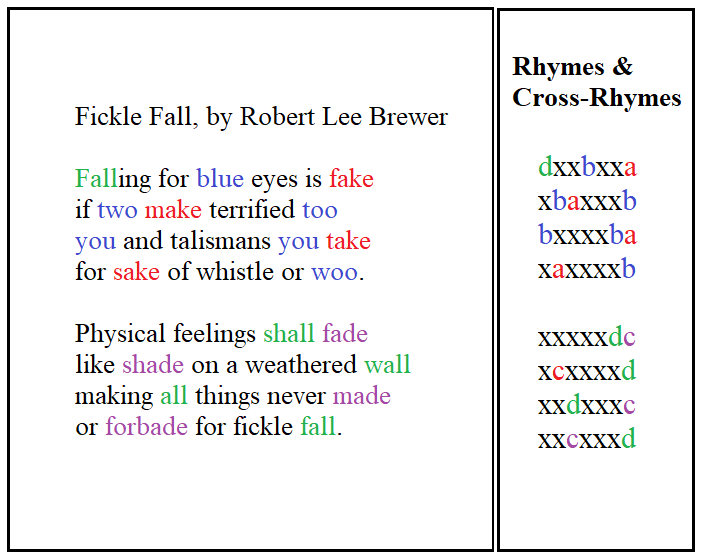
Key Features of the Rannaigheact Mhor*


Structure: Written in any number of quatrains

Rhyme:
– Features an abab rhyme scheme, including consonant end sounds
– At least 2 cross-rhymes in each couplet of each quatrain
– Final word of line 3 rhymes with interior of line 4

Syllables: Seven-syllable lines (heptasyllabic)

Alliteration: At least two words alliterate in each line

Ending:
– Final word of line 4 alliterates with preceding stressed word
– Final sound of poem echoes first sound of poem (common for Irish forms)

*Adapted from this Writer’s Digest post

Example Poem & Rhyme Guide

~~~~~~~~~~~~~~~~

An Original Rannaigheact Mhor

Wear a Mask

Please preserve faith in science;
Compliance flattens the curve.
This deserves an alliance;
This defiance doesn’t serve.

Some won’t see the greater good,
But agree we should be free.
I’d quickly flee If I could,
But that would serve only me.

~~~~~~~~~~~~~~~~

Want to Learn More? Start Here:

Rannaigheact Mhor – Writer’s Digest
Rannaigheact Mhor Poem – Poems and Quotes

~~~~~~~~~~~~~~~~

Come back every Friday for a new form!

~ Creative works are owned by the author and subject to copyright laws ~

Write your own Rannaigheact Mhor and share in the comments!

Week Fifty: Invented Form

The Switchfoot

As I wind down this poetry challenge (I can’t believe I’ve been doing this for over a year!), I thought I’d temporarily break away from the traditional forms to devise one of my own. Since many of my favorite forms have a metrical component to them, I thought I would focus on meter for my own form. Without further ado, I give you: The Switchfoot.

In the Switchfoot, we put one (metrical) foot in front of other, featuring a different type of metrical foot in each line of a stanza. It’s an exercise in metrical versatility and a great way to practice writing in different meters. (See the chart below for twelve common types of metrical feet).

Twelve metrical feet and their accents. Courtesy of Wikipedia.


Key Features of The Switchfoot


Structure: any number stanzas, up to twelve lines per stanza

Content: each line of a stanza must feature a different metrical foot type

~~~~~~~~~~~~~~~

An Original Switchfoot

it is the sun burning

it is
the sun
burning
bright heart
and it is
everywhere
erupting
with its light
without stars
no world can
live but each
world star dims

A Note on My Original Poem

I wanted my original poem to be a clear example of the form at work, so I set out to with the following goals in mind: 1) I wanted each line to feature a single metrical foot, 2) I wanted to feature each of the twelve metrical foot types in a single stanza, and 3) I wanted to use them in order as listed in the chart provided above. I believe I’ve done this successfully. Now, whether or not all of this adds up to a poem that is successful in it’s own right, I’ll let you be the judge!

~~~~~~~~~~~~~~~~

Want to Learn More? Start Here:

Foot (Prosody) – Wikipedia

~~~~~~~~~~~~~~~~

Come back every Friday for a new form!

~ Creative works are owned by the author and subject to copyright laws ~

Write your own Switchfoot and share in the comments!

Week Forty-Nine: The Cento

Meet the Cento

The Cento is a collage poem (cento in Italian literally means ‘patchwork’) made entirely of lines lifted from other poems, often from a variety of authors. This juxtaposition of voices often highlights interesting contrasts and creates unique conversations between poets and poems no longer bound by time, space, or original context. When taken to its extreme, this collision of verse can reach the point of absurd hilarity, as in John Ashbery’s ‘The Dong With the Luminous Nose’.

Key Features of the Cento

Content: Contains only lines borrowed from other poems and poets.

~~~~~~~~~~~~~~~~

An Original Cento

The Sky Gave Me Its Heart

The sky gave me its heart
No one believed what happened
Will they wake with their hearts wanting to play,
fallen Phoenix—that sang out from the fire of union

There are wars where no one marches with a flag,
so I run to my garden and start digging potatoes
with such love and power

Most carry their values and knowledge in a jug

I guess I should not have jumped naked
desperate, in need of
a blessed gratitude
and even a man can become

A note on my original cento

I chose to create my poem from a single anthology: Love Poems from God: Twelve Sacred Voices from the East and West, edited and translated by Daniel Ladinsky. From this anthology, I decided to borrow one line from each of the twelve featured poets in sequential order. The line number from each line in the original poem coincides with the number of the line used in my cento. For example, the third line of Rumi’s ‘The Way Wings Should’ became the third line of my own poem, and so on through the poem’s twelve lines. My cento features one line from each of these poets (listed in order): Rabia, St. Francis of Assisi, Rumi, Meister Eckhart, St. Thomas Aquinas, Hafiz, St. Catherine of Siena, Kabir, Mira, St. Teresa of Avila, St. John of the Cross, Tukaram.

~~~~~~~~~~~~~~~~

Want to Learn More? Start Here:


Cento Poems – Writer’s Digest
Cento – Poets.org
Cento – Wikipedia
How to Write a Cento – Write Shop

~~~~~~~~~~~~~~~~

Come back every Friday for a new form!

~ Creative works are owned by the author and subject to copyright laws ~

Write your own Cento and share in the comments!

Week Forty-Eight: The Rispetto

Meet the Rispetto

This classic Italian lyric form expresses love or respect (rispetto) as its subject that has many variations. The variation I’ve chosen for my own poem is similar in many ways to the Ottava Rima, another popular stanzaic Italian form.

Key Features of the Rispetto

*Note – These describe but one of many variations of the form

Structure: Contains one stanza made of eight lines (octave/octet)

Rhyme: ababccdd or abababcc

Syllables: eleven-syllable lines (hendecasyllabic)

Content: Traditionally expresses love or respect (rispetto) to the subject

~~~~~~~~~~~~~~~~

An Original Rispetto

My Muse, she sings but softly

My Muse, she sings but softly these warring days
With her harmonious sisters Voice and Verse;
Their chantsongs echoing faint and far away,
Will not reach me here to end this silent curse.
To dark and ancient music, to thund’rous drums,
We used to dance the twilight, shimmer, and hum.
I need their sweet music, their timbre, and tone.
I can hardly bear to sing my voice alone.

~~~~~~~~~~~~~~~~

Want to Learn More? Start Here:

Rispetto – Writer’s Digest
Rispetto – Shadow Poetry
Rispetto – Britannica
The Rispetto – Verse Forms

~~~~~~~~~~~~~~~~

Come back every Friday for a new form!

~ Creative works are owned by the author and subject to copyright laws ~

Write your own Rispetto and share in the comments!

Week Forty-Seven: Seguidilla

Dancing with the Seguidilla

The term Seguidilla can refer to either the Spanish dance form or the poetic form that evolved from it.

Key Features of the Seguidilla

Form: Consists of any number of seven-line stanzas

Content: Features a pause and tone change at the end of line 5

Rhyme: Assonance (vowel sound) rhymes between lines 2 and 4, and 5 and 7

Syllables: Counted 7/5/7/5/5/7/5

~~~~~~~~~~~~~~~~

An Original Seguidilla

June 2020

The legendary dance halls
Of Barcelona    
Are empty; all the dancers
Are dancing at home.
Meanwhile, in Tulsa
A stadium filled with hate
Is losing control.

~~~~~~~~~~~~~~~~

Want to Learn More? Start Here:

Seguidilla – Writer’s Digest
Sequidilla (Poetry) – Wikipedia
Seguidilla – Wikipedia

~~~~~~~~~~~~~~~~

Come back every Friday for a new form!

~ Creative works are owned by the author and subject to copyright laws ~

Write your own Seguidilla and share in the comments!

Week Forty-Six: The Nonet

Nine is the Number

In music, a nonet refers to a group of nine instruments or performers. In poetry, it refers to a nine-line poem that begins with a nine-syllable line. The nonet is one of a number of ‘shrinking’ forms, such as Diminishing Verse (Week 2)

Key Features of the Nonet

Form: Consists of a single nine-line stanza

Syllables: Begins with nine syllables and diminishes by one with each proceeding line

Rhyme: Optional

~~~~~~~~~~~~~~~~

An Original Nonet

Witness the Power of Growing Things

Witness the power of growing things:
Revolutions of nature, life
Like leaves and petals spreading,
Like stems and trunks rising,
Voluminous fruits,
Tender berries,
Bound in a
Single
Seed.

~~~~~~~~~~~~~~~~

Want to Learn More? Start Here:

Nonet Poems – Writer’s Digest
Nonet – Poetry Dances
Nonet – Shadow Poetry

~~~~~~~~~~~~~~~~

Come back every Friday for a new form!

~ Creative works are owned by the author and subject to copyright laws ~

Write your own Nonet and share in the comments!

Week Forty-Five: Dodoitsu

Meet the Dodoitsu

The Dodoitsu is one of a wide variety of popular Japanese haiku variations. While some poetic forms can seem daunting and overly restrictive, the elegant simplicity of these forms gives them an air of accessibility that is inviting to poets of all ages and levels of experience.

Key Features of the Dodoitsu

Title: Title optional

Form: Usually consists of a single four-line stanza (quatrain)

Syllables: The first three lines contain seven syllables, and the final line contains five

Content: Traditionally have a theme of love or work and occasionally feature a humorous, unexpected twist

~~~~~~~~~~~~~~~~

An Original Dodoitsu

Spring Garden

Black-eyed Susans, snapdragons
and lavender for the bees;
sugar water, Wendy’s Wish
for the hummingbirds.

~~~~~~~~~~~~~~~~

Want to Learn More? Start Here:

Dodoitsu – Writer’s Digest
Dodoitsu – Wikipedia
Dodoitsu – Poets Collective
Dodoitsu – Poetry Magnum Opus

~~~~~~~~~~~~~~~~

Come back every Friday for a new form!

~ Creative works are owned by the author and subject to copyright laws ~

Write your own Dodoitsu and share in the comments!