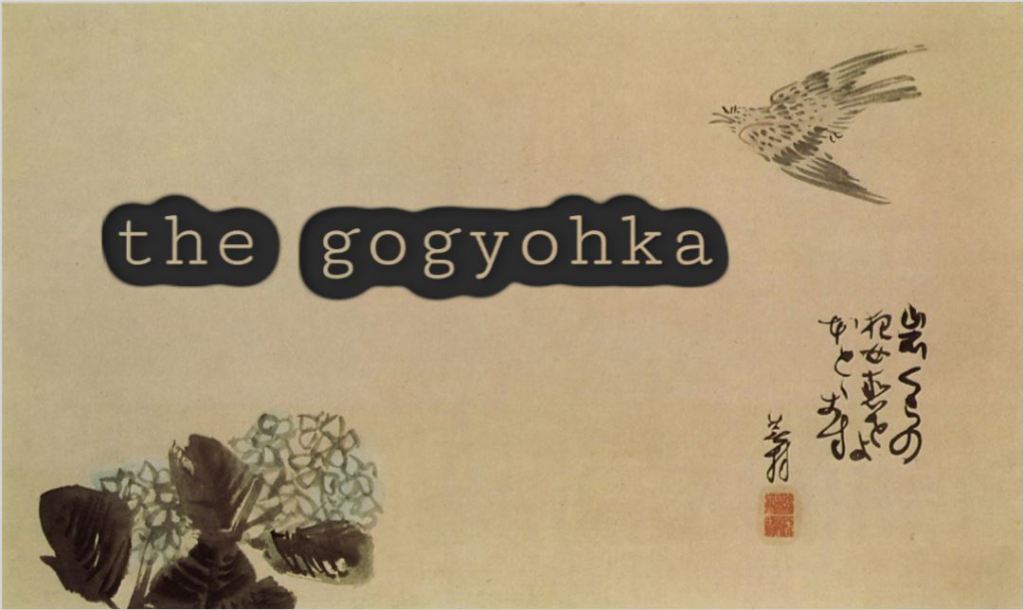
The Japanese love their five-line forms. (I love them too!) The word Gogyohka (sometimes written Gogyōka in English) translates literally from Japanese to mean “five-line form.” An unnamed version of the form has existed at least since the early 1900s, but the popularity of the form today is largely credited to poet Enta Kusakabe who developed and trademarked the gogyohka in 1983 as a freer adaptation of the tanka form.
A Gogyohka by Enta Kusakabe
What kind of stained glass have your rose-coloured cheeks passed through
Enta Kusakabe
Five rules of Gogyohka by Enta Kusakabe*
Gogyohka is a new form of short poem that is based on the ancient Japanese Tanka and Kodai kayo.
Gogyohka has five lines, but exceptionally may have four or six.
Each line of Gogyohka consists of one phrase with a line-break after each phrase or breath.
Gogyohka has no restraint on numbers of words or syllables.
If you enjoyed last week’s form, The Tanka, you should enjoy The Somonka twice as much! It is simply two tankas written in conversation with one another. Traditionally, the somonka reflects upon a theme of love and is written by two authors. But you may find modern somonka written by a single author in two voices. The theme of love may also be adapted and expanded beyond purely romantic sentiments to include love of friends and family, a precious object, or even the world itself.
The Tanka is a Japanese form closely related to the haiku. It’s a slightly longer form–made up of a quintet rather than a tercet–but maintains the haiku’s somewhat strict syllable restrictions. While some of the conventions associated with the haiku are still present–such as the focus on imagery–the tone of the tanka may be more conversational. Restrictions on the use of poetic devices such as metaphor and personification are also more relaxed.
Tanka burning Buddhist statues – Wikimedia Commons
Two Paths to the Tanka
There are two ways to approach the syllable requirements of a Japanese form such as the tanka when composing outside of the original language.
One approach uses the syllable requirements of the English haiku (the well known 5-7-5 rule) as a guide. Following this pattern, the syllable count for the tanka would become 5-7-5-7-7. Strict adherence to this method would result in a tanka of exactly thirty-one syllables. Since the way that syllables are counted in the two languages are not directly comparable, this is only an approximation of the original form.
The second approach is to use what I’ll call the short-long-short method, in which the length of the lines, and the difference between them, is more important than the actual syllable count. Using this method, the lines of the tanka would be written short-long-short-long-long. Using this method, the tanka is often shorter than thirty-one syllables (the number of syllables per line is more likely to be lowered than raised). Some would argue that this method is more in the spirit of the original Japanese form.
*Visit American Tanka for more on the history of the tanka.*
A Tanka by Saigyo*
Beside the roadway a flowing of clear water in a willow’s shade I thought for just a short while to linger and take a rest.
*12th century Japanese poet and priest
Requirements of the Form
Structure
– most often made of a single quintet
Content
Similarities with haiku – focus on brevity, immediacy – use of natural imagery – often features an unexpected “turn” in the final lines of the poem
Differences from haiku – allows figurative language such as metaphor – may have relaxed, more conversational tone
Syllable Count
– Option One (Based on English Haiku): 5-7-5-7-7 – Option Two (Truer to Japanese Form): Short-Long-Short-Long-Long

 Astra Poetica