The Japanese love their five-line forms. (I love them too!) The word Gogyohka (sometimes written Gogyōka in English) translates literally from Japanese to mean “five-line form.” An unnamed version of the form has existed at least since the early 1900s, but the popularity of the form today is largely credited to poet Enta Kusakabe who developed and trademarked the gogyohka in 1983 as a freer adaptation of the tanka form.
A Gogyohka by Enta Kusakabe
What kind of stained glass have your rose-coloured cheeks passed through
Enta Kusakabe
Five rules of Gogyohka by Enta Kusakabe*
Gogyohka is a new form of short poem that is based on the ancient Japanese Tanka and Kodai kayo.
Gogyohka has five lines, but exceptionally may have four or six.
Each line of Gogyohka consists of one phrase with a line-break after each phrase or breath.
Gogyohka has no restraint on numbers of words or syllables.
The Haibun features a fascinating paring of prose poetry and haiku. It was invented and popularized by 17th century Japanese master poet Matsuo Bashō. The prose and haiku of the haibun are often in communication with each other in direct or subtle ways.
I walk the north end of the lake this time every summer. Listen to the murky green waters slap up against the weather beaten dock. In the distance, the sound of children skinny dipping.
from a navy sky sound of cicadas calling full moon on the rise
Requirements of the Form
Structure
– Titled, unlike traditional haiku
– Begins with a small number of short paragraphs (typically one to three) written in prose poetry style
– Ends with a traditional haiku that reflects or is in some relationship with the introductory prose poem
Content
Common elements and themes include: – Strong sense of place through natural imagery and sensory detail – Travel or sense of journey – Autobiographical elements – Economy of language – Sense of presence and immediacy typically found in haiku – Haiku follows other rules typically found in form
Syllable Count
– For the haiku, syllables needn’t be counted 5-7-5 as in the English Haiku. Rather, aim for a short first line, followed by a longer line, ending with another short line. This approach more closely reflects the spirit of the traditional Japanese form.
An Original Haibun
October 28, 2019[a haibun]
October is ending. The blazing reds of the sugar maple have begun to yellow. I stand at the front window, still in my bathrobe though noon approaches, still fighting a cold with rest and medication. A small grey cat brushes against my leg and then the curtain. Beside her, a fat tabby dozes on a quilt on a rocking chair. Beside the rocking chair, a wastebasket full of crumpled tissues waits to be emptied.
I refill my coffee mug, warming my hands with it as I return to the window. The leaves on the lawn are beginning to brown, reminding me of the promise to rake. Last year we let them lay and they choked the irises. At the feeder, only the occasional finch returns. The water in the birdbath is not yet frozen.
October ends orange leaves and white snowflakes fall together
Oh, those plucky Welsh forms with their fun names, lively musicality, strict syllable restrictions and internal rhymes. The Clogyrnach is the third Welsh form so far in this challenge (after the gwawdodyn and the cywydd llosgyrnog) and is just as challenging as its fellow forms.
Requirements of the Form
Like many other Welsh forms, there are no restrictions in content or meter, but there are various other requirements that must be adhered to rather strictly.
Form
– Consists of any number of six-line stanzas (sestets)
Syllable Count
– Lines 1 and 2 contain eight syllables – Lines 3 and 4 have five syllables – Lines 5 and 6 have three syllables each
Rhyme
-End rhymes (lines 1-6): aabbba
Variations
– There is a five-line variation* of the Clogyrnach which combines lines 5 and 6. (see below for details)
Requirement Breakdown
1-xxxxxxxa 2-xxxxxxxa 3-xxxxb 4-xxxxb 5-xxb 6-xxa
*Form Variation*
1-xxxxxxxa 2-xxxxxxxa 3-xxxxb 4-xxxxb 5-xxbxxa
An Original Clogyrnach
Fall
I love the autumn’s red and gold, but every fall I catch a cold. So, I’m stuck in bed with a stuffy head until the meds take hold.
I long to stroll beneath the trees breathing in the October breeze. Buried in tissues with sinus issues, I achoo, cough and wheeze.
Lost leaves scattered across the ground, pillows piled in a high white mound; not what I would call an awesome time, ya’ll. Love of fall’s got me down.
An Acrostic poem uses the first letter of each line to spell a word or name central to the theme of the poem. Acrostics have been used in literature and poetry for many hundreds of years. Even today, they are commonly used as mnemonic devices to aid in memory retention and retrieval.
Form Example
“An Acrostic” by Edgar Allan Poe:
Elizabeth it is in vain you say “Love not”—thou sayest it in so sweet a way: In vain those words from thee or L.E.L. Zantippe’s talents had enforced so well: Ah! if that language from thy heart arise, Breath it less gently forth—and veil thine eyes. Endymion, recollect, when Luna tried To cure his love—was cured of all beside— His follie—pride—and passion—for he died.
~
An Original Acrostic Poem
Trump – An Acrostic
Dangerous Delusions Direct this Obnoxious, Obstinate, Orange Narcissist. Negligence and an Arrogant Aggression define this Loud-mouthed Liar, this Destructive Dimwit whose Twitter Temper-Tantrums Repel all but Repugnant Racists. Unite against this Unwelcome, Manipulative Misogynist, this Pussy-grabbing Pig.
The Tanka is a Japanese form closely related to the haiku. It’s a slightly longer form–made up of a quintet rather than a tercet–but maintains the haiku’s somewhat strict syllable restrictions. While some of the conventions associated with the haiku are still present–such as the focus on imagery–the tone of the tanka may be more conversational. Restrictions on the use of poetic devices such as metaphor and personification are also more relaxed.
Tanka burning Buddhist statues – Wikimedia Commons
Two Paths to the Tanka
There are two ways to approach the syllable requirements of a Japanese form such as the tanka when composing outside of the original language.
One approach uses the syllable requirements of the English haiku (the well known 5-7-5 rule) as a guide. Following this pattern, the syllable count for the tanka would become 5-7-5-7-7. Strict adherence to this method would result in a tanka of exactly thirty-one syllables. Since the way that syllables are counted in the two languages are not directly comparable, this is only an approximation of the original form.
The second approach is to use what I’ll call the short-long-short method, in which the length of the lines, and the difference between them, is more important than the actual syllable count. Using this method, the lines of the tanka would be written short-long-short-long-long. Using this method, the tanka is often shorter than thirty-one syllables (the number of syllables per line is more likely to be lowered than raised). Some would argue that this method is more in the spirit of the original Japanese form.
*Visit American Tanka for more on the history of the tanka.*
A Tanka by Saigyo*
Beside the roadway a flowing of clear water in a willow’s shade I thought for just a short while to linger and take a rest.
*12th century Japanese poet and priest
Requirements of the Form
Structure
– most often made of a single quintet
Content
Similarities with haiku – focus on brevity, immediacy – use of natural imagery – often features an unexpected “turn” in the final lines of the poem
Differences from haiku – allows figurative language such as metaphor – may have relaxed, more conversational tone
Syllable Count
– Option One (Based on English Haiku): 5-7-5-7-7 – Option Two (Truer to Japanese Form): Short-Long-Short-Long-Long
Two French forms in as many weeks? C’est fou! Good thing they’re a joy to write! The kyrielle is said to have originated in troubadour poetry, which would place its emergence somewhere between the 11th and 14th centuries. It is also associated with and adapted from the kýrie of Christian liturgy. Like many French forms–including last week’s Triolet— the kyrielle features a simple rhyme scheme, uniform syllable count, and a repeated line in each stanza.
Caption: The troubadour Perdigon playing his fiddle (Wikipedia).
O what’s the weather in a Beard? It’s windy there, and rather weird, And when you think the sky has cleared — Why, there is Dirty Dinky.
Suppose you walk out in a Storm, With nothing on to keep you warm, And then step barefoot on a Worm — Of course, it’s Dirty Dinky.
As I was crossing a hot hot Plain, I saw a sight that caused me pain, You asked me before, I’ll tell you again: — It looked like Dirty Dinky.
Last night you lay a-sleeping? No! The room was thirty-five below; The sheets and blankets turned to snow. — He’d got in: Dirty Dinky.
You’d better watch the things you do. You’d better watch the things you do. You’re part of him; he’s part of you — You may be Dirty Dinky.
**A note on “Dinky”**
Roethke doesn’t stick exactly to the formal requirements presented for the kyrielle below. Traditionally, all lines would contain the same number of syllables.
Requirements of the Form
Structure
– Made of at least three four-line stanzas (quatrains). The last line of each stanza repeats, acting as a refrain. Minor variations in the refrain are allowed to emphasize meaning.
Content
– no restrictions, though historically often with a religious theme
Syllable Count
– traditionally, eight syllables per line
Meter
– poet’s choice, though in English the eight-syllable line requirement works nicely in iambic tetrameter
Rhyme
– historically written as couplets, or aabb pattern, with the fourth line in each stanza repeated as a refrain. Other possible rhyme schemes: abab, aaab, abcb.
An Original Kyrielle
What She’s Due [a Modern Kyrielle)
She chose the way the rivers run, The bubbles burst, the drops of dew Evaporate in morning sun– The Earth won’t ask for what she’s due.
Where multitudes are cut to one And forests shrink where once they grew, There she will end what we’ve begun– The Earth won’t ask for what she’s due.
This war on nature can’t be won– Where skies are black that should be blue– She takes control, she turns the gun– The Earth won’t ask for what she’s due.
The web of life will be re-spun. The natural cycles will renew. When acts of man can’t be undone, The Earth will take just what she’s due.
The Triolet (pronounced TREE-oh-LAY) is a 13th century French form notable for it’s emphasis on repetition and rhyme in a fashion similar to that found in the rondeau or “round” poem. The form remained popular among French poets for several centuries, eventually inspiring English and German attempts and variations through the 18th century and beyond.
Triolet in French means, clover, or clover leaf, more directly translating as three-leaf. In my research I was unable to discover an exact explanation for why this particular form is called the triolet. Perhaps it was because it was often written in French in a meter similar to iambic trimeter. Or perhaps it is a reference to how the first line is repeated three times.
The King of Triolets
This untitled triolet by 17th century French poet Jacques de Ranchin is perhaps the most famous ever written and is often referred to as “the king of triolets.” English translation by Hikaru Kitabayashi.
Le premier jour du mois de Mai Fut le plus heureux de ma vie. Le beau dessein que je formai! Le premier jour du mois de Mai. Je vous vis, & je vous aimai. Et ce dessin vous plut, Sylvie. Le premier jour du mois de Mai Fut le plus heureux de ma vie.
The day that came the first in May, No happier day my life has seen since. The plans I made were good that day, The day that came the first in May. My eyes with love about you lay, And, Sylvie, you became my queen thence, The day that came the first in May. No happier day my life has seen since!
~For a refresher on the hazards of translating poetry, see my previous post “Week Four: The Ovillejo”.~
Requirements of the Form
Structure
– composed of a single eight-line stanza (octave)
Content
– no restrictions, though poets often aim for the repeated lines to take on additional significance as the poem progresses
Syllable Count
– see meter (below)
Meter
– in English, often written in iambic tetrameter. In French, some lines a variation of iambic trimeter tagged with an amphibrach. (see Wikipedia for more on this).
Rhyme
– ABaAabAB, with capital letters representing lines repeated exactly
Requirements Breakdown
Line 1: first line, A rhyme Line 2: second line, B rhyme Line 3: third line, a rhyme Line 4: exact repeat of Line 1, A rhyme Line 5: fifth line, a rhyme Line 6: sixth line, b rhyme Line 7: exact repeat of Line 1, A rhyme Line 8: exact repeat of Line 2, B rhyme
An Original Triolet
Let’s move this town to higher ground
Let’s move this town to higher ground We know these plains will flood again We are not bound to stay and drown Let’s move this town to higher ground A home more sound may yet be found These window panes will fill with rain Let’s move this town to higher ground We know these plains will flood again
*A Note on My Original Triolet
The internal rhyme located on the second stress of each line is not a formal requirement, but a creative choice by the author. I began the poem with the first line, where the internal rhyme felt natural enough, and decided to challenge myself to see if I could carry the pattern through to the end.
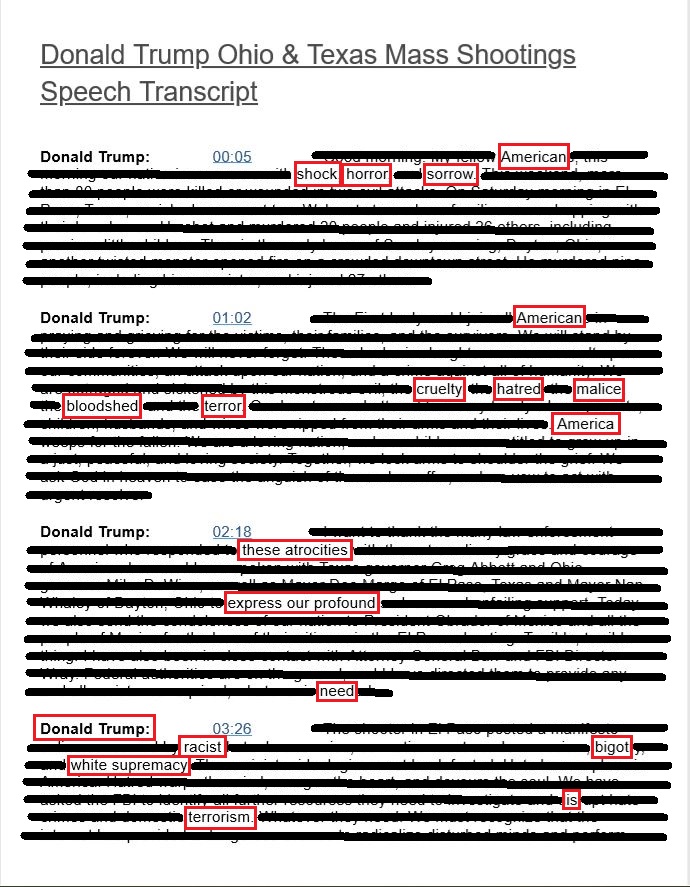
Blackout poetry is a type of erasure poetry that features a strong emphasis on visual presentation. In a blackout poem, a found text is altered in a visually interesting way, emphasizing certain words in order to make a kind of artistic statement. The design of a blackout poem can be as simple or elaborate as the poet pleases.
Notes on Using Found Texts
There are two important things you need to consider before sharing a blackout poem. First, make sure that your original source is cited in some way to avoid potential risk of plagiarism. Second, the original found text must be significantly altered. Robert Lee Brewer at Writer’s Digest states, “If you’re not erasing more than 50% of the text, then I’d argue you’re not making enough critical decisions to create a new piece of art.”
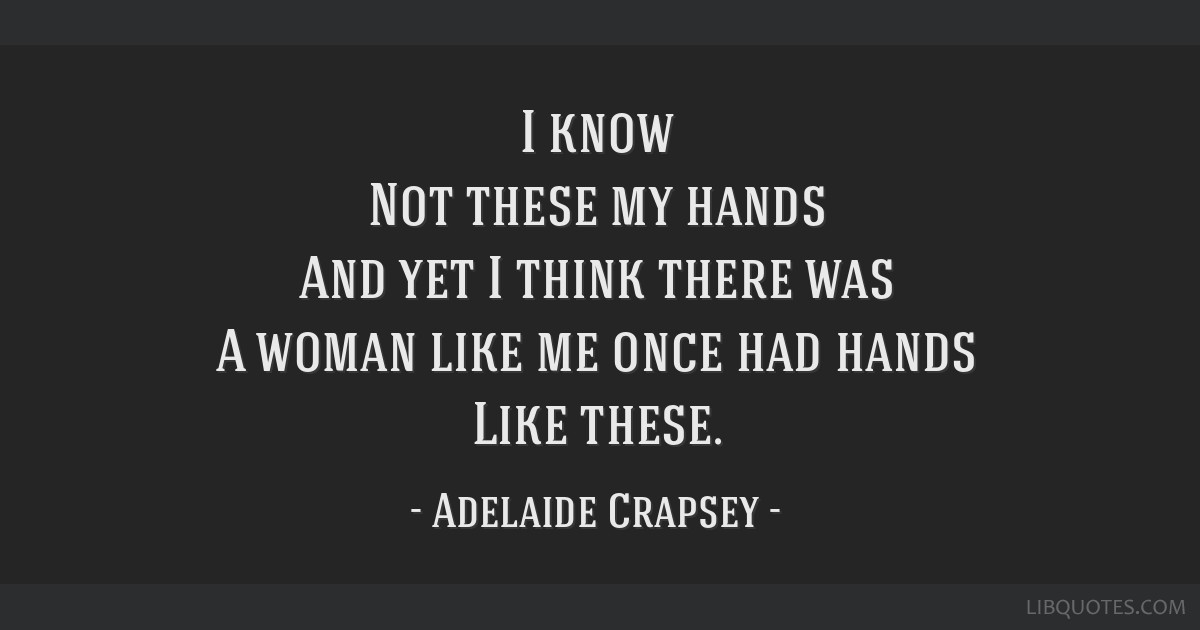
The life of American poet Adelaide Crapsey was both brilliant and brief. Intensely interested in the metrics of poetry, Crapsey had great compact admiration for the meticulousness of the Japanese haiku, and developed her own version of the form, now known as the cinquain (sometimes referred to as the American cinquain to differentiate it from the several variations Crapsey’s original form inspired.) Literature–and poetry in particular–loves a tragic figure, and Crapsey’s fame came after her death from a terminal disease, from which she suffered for many years and greatly influenced the content and tone of her poems. Her first volume of poetry, Verse, was published in 1915.
“Amaze” from Verses (1915)
Variations of the Cinquain
The Didactic Cinquain
The most popular variation of Crapsey’s form is known as the Didactic Cinquain. In this form, words are counted instead of syllables, greatly simplifying the form. Along with the American haiku, didactic cinquains may be one of the first poetic forms you learn about in school. Certain grammatical elements are often assigned to each line to help students learn about grammar at the same time. For more on the didactic cinquain, visit Poet’s Collective.
Requirements of the Form
Structure
– Consists of a short title, followed by a single five-line stanza. The title is not repeated and can be seen as a sixth line. Lines are often enjambed.
Content
– Poet’s choice. However, Crapsey’s cinquains commonly used potent imagery to convey intense mood or feeling.
Syllable Count
– Both syllables and metric feet are carefully counted. The syllable count by line is 2, 4, 6, 8, 2.
Meter
– Poet’s choice, but iambic is generally preferred in English. Since one iambic foot equals two syllables, it fits well within this form.
Rhyme
– Traditionally un-rhymed
Requirements Breakdown
[Title]
[Line 1] Two syllables, one iambic foot [Line 2] Four syllables, two iambic feet [Line 3] Six syllables, three iambic feet [Line 4] Eight syllables, four iambic feet [Line 5] Two syllables, one iambic foot
The Cinquain
You see, This form is not As hard as it might be. And once you get the hang of it, It’s fun!
An Original Cinquain
Swimming lessons
For her dark eyes are pools for my fool eyes to swim and all at once I feel I’m made of waves
The Minute Poem is a modern form of unknown origin. Despite it’s name–and fortunately for us–the Minute Poem is not a poem that you must write in 60 seconds. Rather, it’s a poem consisting of exactly sixty syllables. Further requirements in length, meter, and rhyme help this form stand out and make for a fun and fairly simple challenge.
Lucky for us, the Minute Poem counts syllables, not seconds.
Requirements of the Form
Form
– Consists of three quatrains (four-line stanzas) for a total of twelve lines
Meter
– Strict iambic (unstressed-stressed)
Syllable Count
– Eight syllables in the first line of each stanza – Four syllables in the proceeding lines of each stanza
Rhyme Scheme
– aabb/ccdd/eeff
Requirements Breakdown
1-xxxxxxxa 2-xxxa 3-xxxb 4-xxxb
5-xxxxxxxc 6-xxxc 7-xxxd 8-xxxd
9-xxxxxxxe 10-xxxe 11-xxxf 12-xxxf
An Original Minute Poem
I often sleep through summer’s storm
I often sleep through summer’s storm when nights are warm and thick with dreams or so it seems
the quilt pulled high covers my eyes as lightning flies like moon in shroud of creeping cloud
I wake to find the darkened road the flowers bowed the sagging sky the river high






 Astra Poetica