An Acrostic poem uses the first letter of each line to spell a word or name central to the theme of the poem. Acrostics have been used in literature and poetry for many hundreds of years. Even today, they are commonly used as mnemonic devices to aid in memory retention and retrieval.
Form Example
“An Acrostic” by Edgar Allan Poe:
Elizabeth it is in vain you say “Love not”—thou sayest it in so sweet a way: In vain those words from thee or L.E.L. Zantippe’s talents had enforced so well: Ah! if that language from thy heart arise, Breath it less gently forth—and veil thine eyes. Endymion, recollect, when Luna tried To cure his love—was cured of all beside— His follie—pride—and passion—for he died.
~
An Original Acrostic Poem
Trump – An Acrostic
Dangerous Delusions Direct this Obnoxious, Obstinate, Orange Narcissist. Negligence and an Arrogant Aggression define this Loud-mouthed Liar, this Destructive Dimwit whose Twitter Temper-Tantrums Repel all but Repugnant Racists. Unite against this Unwelcome, Manipulative Misogynist, this Pussy-grabbing Pig.
Along with the English Haiku and the Cinquain, the Alphabet Poem is likely one of the first poetry forms students are introduced to in school. There’s something about the simplicity of the challenge that makes the alphabet poem a lot of fun to play with.
Three Ways to Play with the ABCs
Approach One: List Them Out
Write a poem by listing each letter down the left-hand margin and assigning each letter at least one word. This approach is similar to what you’d find in an anagrammatic poem (more on that in a post to come!) The important thing is that each letter is clearly represented by at least one word.
[see example below: “An Original Alphabet Poem”]
Approach Two: Tell a Story
Write a story using each letter of the alphabet as the first letter of each word. Words can be in alphabetical order, reverse alphabetical order, or any other configuration, as long as each letter is represented by a single word.
Original Example Average bears can’t dance every fourth generation. However, ingenious juveniles know lazy Monday nights often provide quite remarkable situations to unleash various waltzes, xaxados, yurukikos, zydecos.
Approach Three: The Quick Brown Fox Method
The quick brown fox jumps over the lazy dog
This simple phrase is interesting because it includes every letter of the alphabet in nine short words, and eleven syllables. Poets up for a challenge could try to match the efficiency of the above phrase by creating their own collection of words that meet the same criteria in as many words. (Or less, if you can manage it!)
Original Example Quit flummoxing plucky wizard hives by June (7 words, 11 syllables)
My alphabet poem is also a list poem where I’ve listed some of my favorite words to hear and say out loud. What are some words that catch and thrill you when you hear them? The type of word that you can’t help but stop to appreciate and repeat out loud, even if it means interrupting someone in mid-sentence. Comment to share!
If you enjoyed last week’s form, The Tanka, you should enjoy The Somonka twice as much! It is simply two tankas written in conversation with one another. Traditionally, the somonka reflects upon a theme of love and is written by two authors. But you may find modern somonka written by a single author in two voices. The theme of love may also be adapted and expanded beyond purely romantic sentiments to include love of friends and family, a precious object, or even the world itself.
The Tanka is a Japanese form closely related to the haiku. It’s a slightly longer form–made up of a quintet rather than a tercet–but maintains the haiku’s somewhat strict syllable restrictions. While some of the conventions associated with the haiku are still present–such as the focus on imagery–the tone of the tanka may be more conversational. Restrictions on the use of poetic devices such as metaphor and personification are also more relaxed.
Tanka burning Buddhist statues – Wikimedia Commons
Two Paths to the Tanka
There are two ways to approach the syllable requirements of a Japanese form such as the tanka when composing outside of the original language.
One approach uses the syllable requirements of the English haiku (the well known 5-7-5 rule) as a guide. Following this pattern, the syllable count for the tanka would become 5-7-5-7-7. Strict adherence to this method would result in a tanka of exactly thirty-one syllables. Since the way that syllables are counted in the two languages are not directly comparable, this is only an approximation of the original form.
The second approach is to use what I’ll call the short-long-short method, in which the length of the lines, and the difference between them, is more important than the actual syllable count. Using this method, the lines of the tanka would be written short-long-short-long-long. Using this method, the tanka is often shorter than thirty-one syllables (the number of syllables per line is more likely to be lowered than raised). Some would argue that this method is more in the spirit of the original Japanese form.
*Visit American Tanka for more on the history of the tanka.*
A Tanka by Saigyo*
Beside the roadway a flowing of clear water in a willow’s shade I thought for just a short while to linger and take a rest.
*12th century Japanese poet and priest
Requirements of the Form
Structure
– most often made of a single quintet
Content
Similarities with haiku – focus on brevity, immediacy – use of natural imagery – often features an unexpected “turn” in the final lines of the poem
Differences from haiku – allows figurative language such as metaphor – may have relaxed, more conversational tone
Syllable Count
– Option One (Based on English Haiku): 5-7-5-7-7 – Option Two (Truer to Japanese Form): Short-Long-Short-Long-Long
A unique experimental form born of the mashup of eastern and western poetic traditions, the Haiku Sonnet combines the syllable count and three-line stanzaic structure of the English Haiku with the fourteen-line structure of the sonnet. I first learned of the form –and many of the forms collected for this challenge– from David Lee Brewer at Writer’s Digest, but the form appears to be an invention of Chicago poet David Marshall.
David Marshall on the Haiku Sonnet
Conceptually, it’s an attempt to wed two like and unlike forms. To me, the sonnet seems the quintessential western poetic form, defined by the order and rationality of its problem-resolution organization. Depending how you see it, the haiku might be just as organized—haiku certainly have strong rules and conventions. Because haiku can rely, just as a sonnet does, on a sort of reversal—a “volta” in sonnets, a “kireji” in haiku—they may be distant cousins. However, haiku are eastern, and, where sonnets are rational, haiku are resonant. Where sonnets solve—or attempt to solve—haiku observe.
I remember winter now that it’s here—the next word in a song, a plea
for love you forget until a character speaks. Now I remember—
outside this window, one leaf clung all winter. Wind set it fluttering
like a hummingbird. Its sociable flicker was like life. One day
it flew away, and I thought— it wouldn’t ever come back.
Requirements of the Form
Structure
– Four three-line stanzas (tercets) followed by two-line stanza (couplet) for a total of fourteen lines
Content
– Written in the present tense – Syntax may be incomplete to maximize power of brevity – Refers to time of day or season – Focuses on a natural image – ‘Show, don’t tell’ approach – May contain a ‘volta’ or turn of thought – Captures essence of a moment – Aims at sudden insight, spiritual illumination
Syllable Count
– Begins with a sequence of four tercets with a syllable count of 5-7-5 – Ends with a couplet with a syllable count of either 5 or 7 syllables per line
The Lune–also known as the American Haiku–is a thirteen-syllable variation of the English Haiku created by American poet Robert Kelly (it may also be referred to as the Kelly Lune). Kelly’s adaptation of the better-known English Haiku–which also features a tercet, but with the 5-7-5 syllable count we all learned in school–shortened the syllable count from seventeen to thirteen and opened up the form by not requiring some of the haiku’s distinguishing features, such as the focus on nature.
One source proposes that Kelly chose the word lune (the French word for moon) to describe his adapted haiku form because the syllable count matches the thirteen lunar months of the year.
A Lune by Robert Kelly:
thin sliver of the crescent moon high up the real world
Requirements of the Form
Structure
– Consists of any number of tercets, though a single tercet is most common
Content
– Open, but generally has a sense of immediacy — Often lacks punctuation, capitalization
Syllable Count
[Line 1] Five syllables [Line 2] Three syllables [Line 3] Five syllables
Meter
– No requirements
Rhyme
– Typically not rhymed
Three Original Lunes
the woods by the creek
the woods by the creek all our best silences were there
~~~~~~~~~~~~~~~~~~~
she watches, wonders
she watches, wonders in silence the child in the leaves
who will comfort her as she cries as her forests burn
~~~~~~~~~~~~~~~~~~~
from ancient darkness
from ancient darkness sudden light galaxies of soul
The Bop may be the newest form on the list and it won’t have you counting syllables or even rhyming–this one is all about structure. With a total of twenty lines, it’s also the longest form so far. It’s got a set number of stanzas and line count with a refrain between stanzas, but beyond that, it’s pretty open. The problem/solution aspect of the poem (more on that below) adds an interesting twist to the form.
The Bop was invented and developed by celebrated Baltimore poet, Afaa Michael Weaver, winner of many prestigious awards including a Fulbright Scholarship and a fellowship from the National Endowment for the Arts. His most recent poetry collection, Spirit Boxing, was published in 2017.
Caption: Afaa Michael Weaver–acclaimed poet, short-story writer, editor, and inventor of The Bop.
Example – “Rambling”
“Rambling” by Afaa Michael Weaver – 1950- in Lewisburg Federal Penitentiary
In general population, census is consensus—ain’t nowhere to run to in these walls, walls like a mind— We visitors stand in a yellow circle so the tower can frisk us with light, finger the barrels on thirsty rifles.
I got rambling, rambling on my mind
In general population, madness runs swift through the river changing, changing in hearts, men tacked in their chairs, resigned to hope we weave into air, talking this and talking that and one brutha asks Tell us how to get these things They got, these houses, these cars. We want the real revolution. Things…
I got rambling, got rambling on my mind
In the yellow circle the night stops like a boy shot running from a Ruger 9mm carrying .44 magnum shells, a sista crying in the glass booth to love’s law, to violence of backs bent over to the raw libido of men, cracking, cracking, crack…
I got rambling, rambling on my mind
Requirements of the Form
Structure
– Made of three stanzas, each followed by a single-line refrain. — Stanza 1 contains six lines — Stanza 2 contains eight lines — Stanza 3 contains six lines
Content
– Poet’s choice, but often a problem or conflict is introduced in the first stanza, which is then expanded up in the second stanza, and resolved (if possible) in the third.
–Don’t forget the single-line refrain after each stanza.
Syllable Count
– no requirements
Meter
– no requirements
Rhyme
– no requirements
An Original Bop
We were born between rivers [an original bop]
We were born between rivers in the green heart of the fertile valley. Our skin grew rich with sun and deep black soil. We saw a light and recognized a soul. Our dark eyes grew wide and pulsed with power. Our hands grew strong and eager and began to drum.
I do not know what it is—but I know it is in me.
In the chant we found a human voice; we cried and sang. We danced and the rhythm overtook our feet. Our feet that could not stop began to wander. In our wandering we found a world unconquered and in our new restlessness set to test our will against it. We marched from war to war–war within and war without– and we forgot the soul, the voice, the dance.
I do not know what it is—but I know it is in me.
When we remember our soul like water flowing, our eyes like oceans swimming in starlight, our hands like branches reaching, our feet like roots plunging, seeking a center, We will then remember the strength of stillness. We will then remember the power of peace.
I do not know what it is—but I know it is in me.
A note on my original bop
My refrain is taken from the following quote: “There is that in me—I do not know what it is—but I know it is in me.” — Walt Whitman, Leaves of Grass, Part 50
Two French forms in as many weeks? C’est fou! Good thing they’re a joy to write! The kyrielle is said to have originated in troubadour poetry, which would place its emergence somewhere between the 11th and 14th centuries. It is also associated with and adapted from the kýrie of Christian liturgy. Like many French forms–including last week’s Triolet— the kyrielle features a simple rhyme scheme, uniform syllable count, and a repeated line in each stanza.
Caption: The troubadour Perdigon playing his fiddle (Wikipedia).
O what’s the weather in a Beard? It’s windy there, and rather weird, And when you think the sky has cleared — Why, there is Dirty Dinky.
Suppose you walk out in a Storm, With nothing on to keep you warm, And then step barefoot on a Worm — Of course, it’s Dirty Dinky.
As I was crossing a hot hot Plain, I saw a sight that caused me pain, You asked me before, I’ll tell you again: — It looked like Dirty Dinky.
Last night you lay a-sleeping? No! The room was thirty-five below; The sheets and blankets turned to snow. — He’d got in: Dirty Dinky.
You’d better watch the things you do. You’d better watch the things you do. You’re part of him; he’s part of you — You may be Dirty Dinky.
**A note on “Dinky”**
Roethke doesn’t stick exactly to the formal requirements presented for the kyrielle below. Traditionally, all lines would contain the same number of syllables.
Requirements of the Form
Structure
– Made of at least three four-line stanzas (quatrains). The last line of each stanza repeats, acting as a refrain. Minor variations in the refrain are allowed to emphasize meaning.
Content
– no restrictions, though historically often with a religious theme
Syllable Count
– traditionally, eight syllables per line
Meter
– poet’s choice, though in English the eight-syllable line requirement works nicely in iambic tetrameter
Rhyme
– historically written as couplets, or aabb pattern, with the fourth line in each stanza repeated as a refrain. Other possible rhyme schemes: abab, aaab, abcb.
An Original Kyrielle
What She’s Due [a Modern Kyrielle)
She chose the way the rivers run, The bubbles burst, the drops of dew Evaporate in morning sun– The Earth won’t ask for what she’s due.
Where multitudes are cut to one And forests shrink where once they grew, There she will end what we’ve begun– The Earth won’t ask for what she’s due.
This war on nature can’t be won– Where skies are black that should be blue– She takes control, she turns the gun– The Earth won’t ask for what she’s due.
The web of life will be re-spun. The natural cycles will renew. When acts of man can’t be undone, The Earth will take just what she’s due.
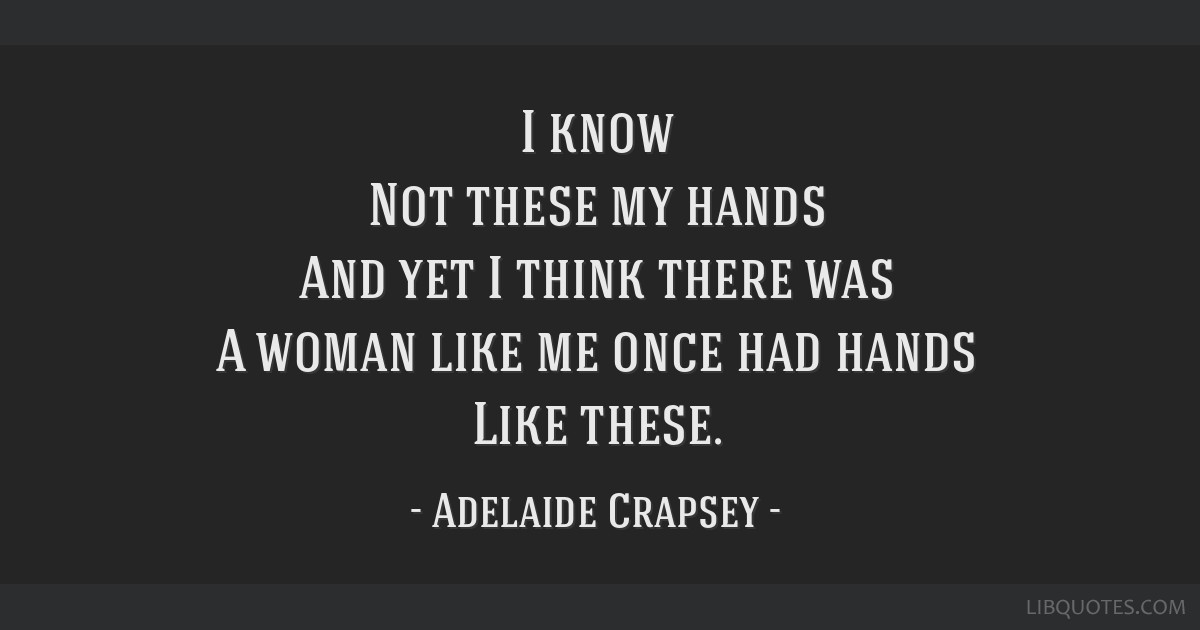
The life of American poet Adelaide Crapsey was both brilliant and brief. Intensely interested in the metrics of poetry, Crapsey had great compact admiration for the meticulousness of the Japanese haiku, and developed her own version of the form, now known as the cinquain (sometimes referred to as the American cinquain to differentiate it from the several variations Crapsey’s original form inspired.) Literature–and poetry in particular–loves a tragic figure, and Crapsey’s fame came after her death from a terminal disease, from which she suffered for many years and greatly influenced the content and tone of her poems. Her first volume of poetry, Verse, was published in 1915.
“Amaze” from Verses (1915)
Variations of the Cinquain
The Didactic Cinquain
The most popular variation of Crapsey’s form is known as the Didactic Cinquain. In this form, words are counted instead of syllables, greatly simplifying the form. Along with the American haiku, didactic cinquains may be one of the first poetic forms you learn about in school. Certain grammatical elements are often assigned to each line to help students learn about grammar at the same time. For more on the didactic cinquain, visit Poet’s Collective.
Requirements of the Form
Structure
– Consists of a short title, followed by a single five-line stanza. The title is not repeated and can be seen as a sixth line. Lines are often enjambed.
Content
– Poet’s choice. However, Crapsey’s cinquains commonly used potent imagery to convey intense mood or feeling.
Syllable Count
– Both syllables and metric feet are carefully counted. The syllable count by line is 2, 4, 6, 8, 2.
Meter
– Poet’s choice, but iambic is generally preferred in English. Since one iambic foot equals two syllables, it fits well within this form.
Rhyme
– Traditionally un-rhymed
Requirements Breakdown
[Title]
[Line 1] Two syllables, one iambic foot [Line 2] Four syllables, two iambic feet [Line 3] Six syllables, three iambic feet [Line 4] Eight syllables, four iambic feet [Line 5] Two syllables, one iambic foot
The Cinquain
You see, This form is not As hard as it might be. And once you get the hang of it, It’s fun!
An Original Cinquain
Swimming lessons
For her dark eyes are pools for my fool eyes to swim and all at once I feel I’m made of waves





 Astra Poetica