Week Ten: The American Cinquain

Adelaide Crapsey (1878-1914)

The life of American poet Adelaide Crapsey was both brilliant and brief. Intensely interested in the metrics of poetry, Crapsey had great compact admiration for the meticulousness of the Japanese haiku, and developed her own version of the form, now known as the cinquain (sometimes referred to as the American cinquain to differentiate it from the several variations Crapsey’s original form inspired.) Literature–and poetry in particular–loves a tragic figure, and Crapsey’s fame came after her death from a terminal disease, from which she suffered for many years and greatly influenced the content and tone of her poems. Her first volume of poetry, Verse, was published in 1915.
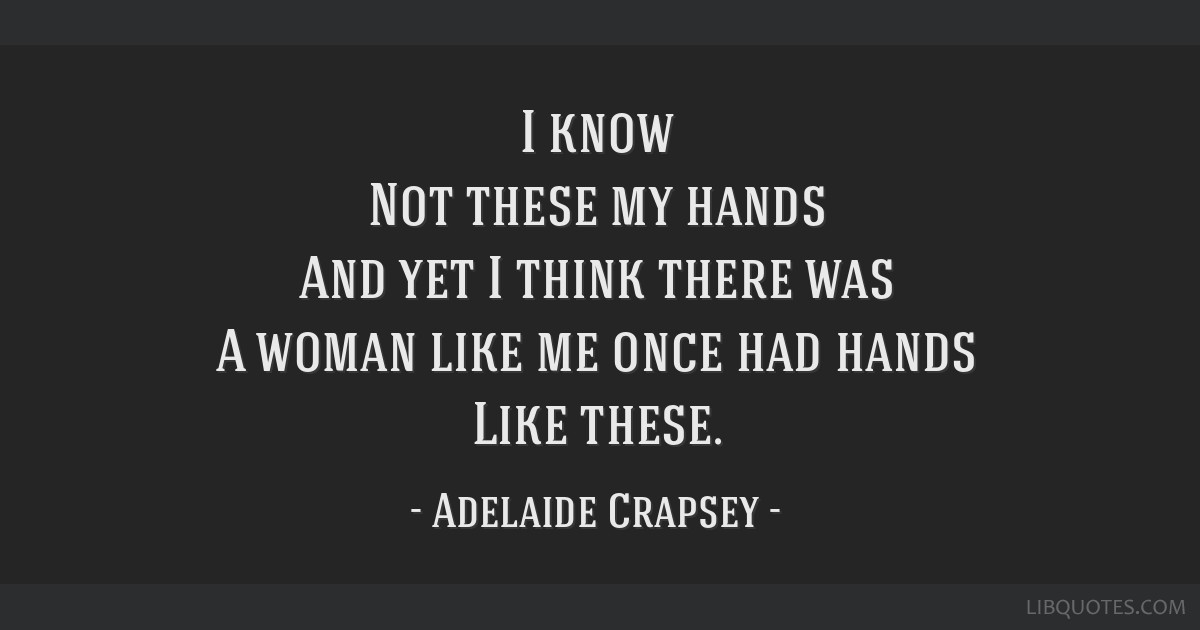
“Amaze” from Verses (1915)

Variations of the Cinquain

The Didactic Cinquain

The most popular variation of Crapsey’s form is known as the Didactic Cinquain. In this form, words are counted instead of syllables, greatly simplifying the form. Along with the American haiku, didactic cinquains may be one of the first poetic forms you learn about in school. Certain grammatical elements are often assigned to each line to help students learn about grammar at the same time. For more on the didactic cinquain, visit Poet’s Collective.

Requirements of the Form

Structure

– Consists of a short title, followed by a single five-line stanza. The title is not repeated and can be seen as a sixth line. Lines are often enjambed.

Content

– Poet’s choice. However, Crapsey’s cinquains commonly used potent imagery to convey intense mood or feeling.

Syllable Count

– Both syllables and metric feet are carefully counted. The syllable count by line is 2, 4, 6, 8, 2.

Meter

– Poet’s choice, but iambic is generally preferred in English. Since one iambic foot equals two syllables, it fits well within this form.

Rhyme

– Traditionally un-rhymed

Requirements Breakdown

[Title]

[Line 1] Two syllables, one iambic foot
[Line 2] Four syllables, two iambic feet
[Line 3] Six syllables, three iambic feet
[Line 4] Eight syllables, four iambic feet
[Line 5] Two syllables, one iambic foot

The Cinquain

You see,
This form is not
As hard as it might be.
And once you get the hang of it,
It’s fun!

An Original Cinquain

Swimming lessons

For her
dark eyes are pools
for my fool eyes to swim
and all at once I feel I’m made
of waves

Links to Online Resources

Adelaide Crapsey – Poetry Foundation
Cinquain – Writer’s Digest
Cinquain – Wikipedia
Week Nine: The Horatian Ode

Horace (65 – 8 BCE)

Quintus Horatius Flaccus–better known to the English-speaking world by the mononym Horace–was a Roman soldier, lyric poet and satirist during the time of Augustus. He was a leading Latin poet of his time and is still celebrated for his odes, satires, and epistles. “Ars Poetica,” or “The Art of Poetry,” (c. 19 BC), his most influential epistle, offers advice on the art of writing poetry and drama.

Horatian Odes

Horace studied Greek ode forms–works by celebrated Greek poets such as Alcaeus, Anacreon, and Pindar–and adapted them for his own purposes, making them suitable for Latin. He not only changed the formal conventions of the Greek odes (stanzaic patterns, meter, rhyme scheme), but also modified the tone and subject matter to best highlight his own unique artistic sensibilities. While Greek odes tended to be heroic–elaborately glorifying a person or event–Horace’s odes were more personal, contemplative, and philosophical. The odes of Horace are also known for their charm, sophistication, and occasional touches of light humor.

Reading Horace

Non-Latin readers are immediately confronted with the challenge of translation. It is widely considered a fool’s errand to attempt to preserve formal conventions such as meter and rhyme when translating poetry, so you’ll need to regard any English translations of Horace’s work as approximating the art and meaning of Horace’s original odes, rather than duplicating their formal conventions.

That being said, there is a great deal to be gained by reading Horace–keeping this limitations in mind–in English and many translations are available online. For the bookshelf, I recommend Oxford World’s Classic’s Horace: The Complete Odes and Epodes featuring translations by David West.

A Horatian Ode in English

Although we can’t look directly to Horace to learn the conventions of his signature odes (without first learning Latin, that is), we can, however, look to Horatian odes written in English by English poets, and there are several good examples. Perhaps the most famous of these is Andrew Marvell’s “An Horatian Ode upon Cromwell’s Return from Ireland”.

The forward youth that would appear 
Must now forsake his Muses dear, 
Nor in the shadows sing 
His numbers languishing. 
’Tis time to leave the books in dust, 
And oil th’ unused armour’s rust, 
Removing from the wall 
The corslet of the hall. 
So restless Cromwell could not cease 
In the inglorious arts of peace, 
But thorough advent’rous war 
Urged his active star. 

Scanning the first eight lines of Marvell’s Horatian ode reveals several key requirements of the form. Firstly, you’ll notice each two lines feature an end rhyme in an aabbccdd… pattern. Secondly, you’ll notice that while lines 1 and 2 are written in iambic tetrameter, lines 3 and 4 are written in iambic trimeter. Thirdly, you’ll notice that–and this is an important feature unique to the Horatian ode–the pattern set in the first four lines is repeated without variation in each subsequent quatrain.

Requirements of the Form

Structure

Any number of stanzas that unvaringly follow the pattern set by the first stanza. Stanzas can be of any length, but Horatian odes usually feature repeating stanzas of two to four lines. Enjambment is allowed.

Content

– Tone tends toward philosophical, contemplative, gently playful, tranquil
– Style is sophisticated and formal, but not restrictive

Meter

Meter is chosen at the discretion of the poet. Again, the important factor is consistency from stanza to stanza. Iambic meter is commonly used in English.

Rhyme

Rhyme schemes vary, but (again) subsequent stanzas must repeat the pattern set by the first stanza. Lines are always end-rhymed.

An Original Horatian Ode

A Horatian Ode to the World Goddess

The Goddess of the World, I sing–
Her many forms and faces bring
The light of fertile life,
The fear of judgement’s knife.

Like Draupadi of Indian fame,
Born of the sacrificial flame–
Where she perceives a wall,
Illusion’s palace falls.

Or Anath, golden Canaanite,
Her retribution fierce and right,
She’ll cut you with a word,
Then feed you to the birds.

Online Resources

Ode – Wikipedia
Odes: Praise Poetry! – Writer’s Digest
An Horatian Ode upon Cromwell’s Return from Ireland – Poetry Foundation
Ode – Poetry Foundation
How to Write an Horatian Ode – Forward Poetry
The Horatian Ode – Poetry Magnum Opus

Week Eight: The Cywydd llosgyrnog

The Cywhatnow?

The Cywydd llosgyrnog is the second Welsh form of this challenge and includes many of the features you come to expect from a Welsh form including: strict syllable count, both end rhymes and internal rhymes, and an extremely difficult-to-pronounce (and spell) name!

Using this handy online Guide to Welsh Pronunciation, the best I can suss out as far as the pronunciation of this form would sound something like “kuh-with th-laws-gurr-nog,” but please understand this is only an educated guess.

Requirements of the Form

The Cywydd llosgyrnog form prescribes no restrictions in content or meter, but there are various other requirements that must be adhered to rather strictly.

Form

– Consists of any number of single six-line stanzas (sestets)

Syllable Count

– Lines 1, 2, 4 and 5 contain eight syllables 
– Lines 3 and 6 have seven syllables 

Rhyme

-End rhymes (lines 1-6): aabccb
-Internal rhymes (lines 3 and 6*): ac
*generally falling on syllable 3 or 4

Requirement Breakdown*

1-xxxxxxxa
2-xxxxxxxa
3-xxxaxxb
4-xxxxxxxc
5-xxxxxxxc
6-xxxcxxb

*adapted, with thanks, from Writer’s Digest

An Original Cywydd llosgyrnog

When I stop to watch

When I stop to watch the deep blue
Evening descend and the last few
Fading hues of daylight’s dream
Diffuse into the sloping plains
A peace upon my mind again
Falls like rain into a stream

Online Resources

A Guide to Welsh Pronunciation – go4awalk.com
Cywydd llosgyrnog – Writer’s Digest
Cywydd – Wikipedia
Cywydd llosgyrnog – Poet’s Collective
Cywydd llosgyrnog – Poetry Magnum Opus

Week Seven: The Minute Poem

The Minute Poem is a modern form of unknown origin. Despite it’s name–and fortunately for us–the Minute Poem is not a poem that you must write in 60 seconds. Rather, it’s a poem consisting of exactly sixty syllables. Further requirements in length, meter, and rhyme help this form stand out and make for a fun and fairly simple challenge.

Lucky for us, the Minute Poem counts syllables, not seconds.

Requirements of the Form

Form

– Consists of three quatrains (four-line stanzas) for a total of twelve lines

Meter

– Strict iambic (unstressed-stressed)

Syllable Count

– Eight syllables in the first line of each stanza
– Four syllables in the proceeding lines of each stanza

Rhyme Scheme

aabb/ccdd/eeff

Requirements Breakdown

1-xxxxxxxa
2-xxxa
3-xxxb
4-xxxb

5-xxxxxxxc
6-xxxc
7-xxxd
8-xxxd

9-xxxxxxxe
10-xxxe
11-xxxf
12-xxxf

An Original Minute Poem

I often sleep through summer’s storm

I often sleep through summer’s storm
when nights are warm
and thick with dreams
or so it seems

the quilt pulled high covers my eyes
as lightning flies
like moon in shroud
of creeping cloud

I wake to find the darkened road
the flowers bowed
the sagging sky
the river high

Online Resources

Minute Poetry – Shadow Poetry
Minute Poem – Poetry Dances
Minute Poem – Writer’s Digest

Week Six: The Décima

**Special Announcement: This week’s post will feature a bonus original poem from poet and singer-songwriter Brandon Barnett!**

Meet the Décima

The Décima poetic form is widely used in poetry and song throughout Spain and Latin America, though the requirements may vary somewhat by region. People who write and perform décimas are often referred to as decimistas or deimeros. The form is also known as the espinela in Spanish, after the creator of the modern version of the décima, writer and musician Vicente Gómez Martínez-Espinel.

Photo caption: Spanish writer and musician Vicente Gómez Martínez-Espinel

Regional Variations

A few regional variations are listed below. Pick your favorite, or try them all!

Puerto Rico: Consists of a 10-line stanza, with 8 syllables per line (octosyllabic) and an abbaaccddc rhyme scheme

Italy: The decima Italiana is a 10-line poem, with 8-syllable lines and an ababcdedec rhyme scheme

Ecuador: Here the décima is a 44-line poem made up of a quatrain and four ten-line stanzas. It’s nearly identical to the glosa poetic form

Poetry and Song

The song form of the décima usually consists of 44 lines and is often improvised. Much like the “freestyle rap battle” of modern hip-hop, Decimeros often challenge one another with dueling songs as a way to show off the composer’s wit and skill.

Requirements of the Form

The requirements listed below are for the Puerto Rican poetic form:

Form

– Single 10-line stanza

Content

-Subject matter varies widely, but common themes include philosophy religion, and politics. Satirical décimas are often humorous.

Syllable Count

– 8 syllables per line

Rhyme Scheme

– abbaaccddc

An Original Décima Poem

After Maria

The cameras flash, Trump fakes a smile;
He holds his breath, swallows a growl,
And throws a roll of paper towels.
Empathy missed by a mile
For Puerto Rico, enchanted isle.
No concern for the common health
of neighbors in the commonwealth;
Once slaving for the hacienda,
Victims of encomienda,
They fight to own a sense of self.

*An Original Décima Poem by Special Guest, Brandon Barnett*

We never knocked on rust-streaked doors
but entered like the bums we were
with hair so ragged–greased like fur–
and alcohol from every pore

The only word we spoke was “more!”
with glassy eyes on shining things
refulgent suds the evening brings
and singing out in harmony

But all that now is far from me
Though oft-recalled with mem’ry strings

Online Resources

Decima – Wikipedia
The Decima –  Puerto Rican Cuatro Project
Decima – Writer’s Digest
Decima Poem Lesson – American Collection
Vicente Espinel – Wikipedia

The Miltonic Sonnet

52 Forms Revisited: this post has been revised and streamlined with refreshed links and new original content (November 2025)

John Milton (1608-1674)

The Miltonic Sonnet is named after the 17th century English poet, political writer, and civil servant, John Milton. With the publishing of his epic poem Paradise Lost, widely regarded as one of the greatest works written in the English language, Milton solidified his reputation as one of the greatest English poets of his time. Milton’s work would go on to influence Romantic poets such as William Blake and William Wordsworth.

Photo caption: A wood engraving from the 19th century depicts a blind John Milton dictating his influential epic poem “Paradise Lost” (Fortuné Louis Méaulle / Wellcome Library) 

Milton’s Sonnet

Starting with the then-popular Petrachan sonnet (named for Italian poet-scholar Petrach), Milton made several changes to make the form his own. He took the sonnet out of the category of love poem and brought it into the spheres of politics, religion, and social issues. He also introduced enjambment (the technique of carrying one line through into the next), while at the same time removing the break between the first and second stanzas, thus tightening up the form. By removing the volta (also known as a pivot, or turn) after the octave (first eight lines) and varying the rhyme scheme of the sestet (proceeding six lines), he further reshaped the form.

The following poem—one of Milton’s most famous—demonstrates these contributions to the evolution of the sonnet:

“When I Consider How My Light Is Spent”*

When I consider how my light is spent,
    Ere half my days in this dark world and wide,
    And that one talent which is death to hide
Lodged with me useless, though my soul more bent
To serve therewith my Maker, and present
    My true account, lest He returning chide;
    “Doth God exact day-labor, light denied?”
I fondly ask. But Patience, to prevent
That murmur, soon replies, “God doth not need
    Either man’s work or His own gifts. Who best
    Bear His mild yoke, they serve Him best. His state
Is kingly: thousands at His bidding speed,
    And post o’er land and ocean without rest;
   They also serve who only stand and wait.”

*provided courtesy of Poetry Foundation

Requirements of the Form

Structure

– Fourteen lines
– No spaces between parts (written as a single stanza)
– Lines contain enjambment
eg: Who best / Bear His mild yoke…His state / Is kingly…

Content

– Occasional (celebrating an event), political, and religious subjects
– Unlike other sonnets, does not have a distinct volta (or pivot) after the eighth line

Meter

Iambic pentameter (ten syllables per line, unstressed-stressed pattern).

Rhyme Scheme

– First eight lines (octave): abbaabba
– Preceding six lines (sestet): often cdecde, but variable

An Original Miltonic Sonnet

The viral image haunted every screen—
A photograph too horrid to ignore:
A pair of bloated bodies on the shore.
In Congress followed yet another scene
Of bickering and washing white-hands clean.
No older than The Virgin when she bore
The Savior that they claim to so adore,
The budding mother wonders what they mean.
As children hungry, dirty, sick and scared
Are torn away and locked in concrete halls
Lay weak with worry, overwhelmed with fear,
The value of their lives is weighed and tared;
As Washington debates the costs of walls,
Who dares to speak of Christ’s compassion here?

Notes on My Original Sonnet

I challenged myself to write a sonnet that was true to the Miltonic themes of politics, religion, and current events, and found in the issue of immigration a combination of all three. The line “children hungry, dirty, sick and scared” was taken from this BBC News article and served as the fulcrum of this poem.

Online Resources


Sonnet Examples – Poetry Through the Ages
Miltonic Sonnet – Poetry Magnum Opus
John Milton – Wikipedia
Petrarchan Sonnet – Wikipedia