Week Sixteen: The Haiku Sonnet

Introduction

A unique experimental form born of the mashup of eastern and western poetic traditions, the Haiku Sonnet combines the syllable count and three-line stanzaic structure of the English Haiku with the fourteen-line structure of the sonnet. I first learned of the form –and many of the forms collected for this challenge– from David Lee Brewer at Writer’s Digest, but the form appears to be an invention of Chicago poet David Marshall.
David Marshall on the Haiku Sonnet

Conceptually, it’s an attempt to wed two like and unlike forms. To me, the sonnet seems the quintessential western poetic form, defined by the order and rationality of its problem-resolution organization. Depending how you see it, the haiku might be just as organized—haiku certainly have strong rules and conventions. Because haiku can rely, just as a sonnet does, on a sort of reversal—a “volta” in sonnets, a “kireji” in haiku—they may be distant cousins. However, haiku are eastern, and, where sonnets are rational, haiku are resonant. Where sonnets solve—or attempt to solve—haiku observe.

David Marshall – Haiku Sonnets

A Haiku Sonnet by David Marshall

Remembering

I remember winter
now that it’s here—the next word
in a song, a plea

for love you forget
until a character speaks.
Now I remember—

outside this window,
one leaf clung all winter. Wind
set it fluttering

like a hummingbird.
Its sociable flicker was
like life. One day

it flew away, and I thought—
it wouldn’t ever come back.

Requirements of the Form

Structure

– Four three-line stanzas (tercets) followed by two-line stanza (couplet) for a total of fourteen lines

Content

– Written in the present tense
– Syntax may be incomplete to maximize power of brevity
– Refers to time of day or season
– Focuses on a natural image
– ‘Show, don’t tell’ approach
– May contain a ‘volta’ or turn of thought
– Captures essence of a moment
– Aims at sudden insight, spiritual illumination

Syllable Count

– Begins with a sequence of four tercets with a syllable count of 5-7-5
– Ends with a couplet with a syllable count of either 5 or 7 syllables per line

Meter

– No meter

Rhyme

– Unrhymed

Requirements Breakdown

[Line 1] 5 Syllables
[Line 2] 7 Syllables
[Line 3] 5 Syllables

(repeat for lines 4 – 12)

[Line 13] 5 or 7 Syllables
[Line 14] 5 or 7 Syllables

An Original Haiku Sonnet

Among Cottonwoods

The autumn wind blows–
the storms of summer did not
drown the cottonwood.

From the hollow trunk,
monarchs fly away from death
and the coming frost.

They will return when
the soft white snowdrifts of seeds
burst forth in April.

The artist seated
at the roots will have to wait
to carve the soft wood.

Among cottonwoods,
the soul climbs and reaches out.

Links to Online Resources

Haiku Sonnets – David Marshall
Haiku Sonnet – Writer’s Digest

Week Fifteen: The Lune

Introduction

The Lune–also known as the American Haiku–is a thirteen-syllable variation of the English Haiku created by American poet Robert Kelly (it may also be referred to as the Kelly Lune). Kelly’s adaptation of the better-known English Haiku–which also features a tercet, but with the 5-7-5 syllable count we all learned in school–shortened the syllable count from seventeen to thirteen and opened up the form by not requiring some of the haiku’s distinguishing features, such as the focus on nature.

One source proposes that Kelly chose the word lune (the French word for moon) to describe his adapted haiku form because the syllable count matches the thirteen lunar months of the year.

A Lune by Robert Kelly:

thin sliver of the
crescent moon
high up the real world

Requirements of the Form

Structure

– Consists of any number of tercets, though a single tercet is most common

Content

– Open, but generally has a sense of immediacy
— Often lacks punctuation, capitalization

Syllable Count

[Line 1] Five syllables
[Line 2] Three syllables
[Line 3] Five syllables

Meter

– No requirements

Rhyme

– Typically not rhymed

Three Original Lunes

the woods by the creek

the woods by the creek
all our best
silences were there


~~~~~~~~~~~~~~~~~~~


she watches, wonders

she watches, wonders
in silence
the child in the leaves

who will comfort her
as she cries
as her forests burn

~~~~~~~~~~~~~~~~~~~

from ancient darkness

from ancient darkness
sudden light
galaxies of soul

Links to Online Resources

Lune – Writer’s Digest
Lune – Poets Collective
Poetic Forms: Haiku, Senryu, Tanka, and Lunes – lestersmith.com
Robert Kelly – Poets.org
Robert Kelly (Poet) – Wikipedia
The Lune and Robert Kelly – The Line Break
Various Moons – Poetsonearth.com

**COME BACK NEXT FRIDAY TO SEE THE NEXT FORM:
THE HAIKU SONNET!**

–Original creative works are owned by the
author and subject to copyright laws

Week Fourteen: The Bop

Introduction

The Bop may be the newest form on the list and it won’t have you counting syllables or even rhyming–this one is all about structure. With a total of twenty lines, it’s also the longest form so far. It’s got a set number of stanzas and line count with a refrain between stanzas, but beyond that, it’s pretty open. The problem/solution aspect of the poem (more on that below) adds an interesting twist to the form.

The Bop was invented and developed by celebrated Baltimore poet, Afaa Michael Weaver, winner of many prestigious awards including a Fulbright Scholarship and a fellowship from the National Endowment for the Arts. His most recent poetry collection, Spirit Boxing, was published in 2017.

Caption: Afaa Michael Weaver–acclaimed poet, short-story writer, editor, and inventor of The Bop.

Example – “Rambling”

“Rambling” by Afaa Michael Weaver – 1950-
                in Lewisburg Federal Penitentiary

In general population, census
is consensus—ain’t nowhere to run
to in these walls, walls like a mind—
We visitors stand in a yellow circle
so the tower can frisk us with light,
finger the barrels on thirsty rifles.

I got rambling, rambling on my mind

In general population, madness runs
swift through the river changing, changing
in hearts, men tacked in their chairs,
resigned to hope we weave into air,
talking this and talking that and one brutha
asks Tell us how to get these things
They got, these houses, these cars.
We want the real revolution. Things…

I got rambling, got rambling on my mind

In the yellow circle the night stops
like a boy shot running from a Ruger 9mm
carrying .44 magnum shells, a sista
crying in the glass booth to love’s law,
to violence of backs bent over to the raw
libido of men, cracking, cracking, crack…

I got rambling, rambling on my mind

Requirements of the Form

Structure

– Made of three stanzas, each followed by a single-line refrain.
— Stanza 1 contains six lines
— Stanza 2 contains eight lines
— Stanza 3 contains six lines

Content

– Poet’s choice, but often a problem or conflict is introduced in the first stanza, which is then expanded up in the second stanza, and resolved (if possible) in the third.

–Don’t forget the single-line refrain after each stanza.

Syllable Count

– no requirements

Meter

– no requirements

Rhyme

– no requirements

An Original Bop

We were born between rivers [an original bop]

We were born between rivers in the green
heart of the fertile valley. Our skin grew rich
with sun and deep black soil. We saw a light
and recognized a soul. Our dark eyes grew
wide and pulsed with power. Our hands
grew strong and eager and began to drum.

I do not know what it is—but I know it is in me.

In the chant we found a human voice; we cried
and sang. We danced and the rhythm overtook
our feet. Our feet that could not stop began
to wander. In our wandering we found a world
unconquered and in our new restlessness set
to test our will against it. We marched from
war to war–war within and war without–
and we forgot the soul, the voice, the dance.

I do not know what it is—but I know it is in me.

When we remember our soul like water
flowing, our eyes like oceans swimming
in starlight, our hands like branches reaching,
our feet like roots plunging, seeking a center,
We will then remember the strength of stillness.
We will then remember the power of peace.

I do not know what it is—but I know it is in me.

A note on my original bop

My refrain is taken from the following quote:
“There is that in me—I do not know what it is—but I know it is in me.”
— Walt Whitman, Leaves of Grass, Part 50

Links to Online Resources

Afaa Michael Weaver – Time Magazine
Afaa M. Weaver – Wikipedia
The Bop – Writer’s Digest
The Bop: Poetic Form – Poets.org

**COME BACK NEXT FRIDAY TO SEE THE NEXT FORM:
THE LUNE!**

–Original creative works are owned by the
author and subject to copyright laws

Week Thirteen: The Kyrielle

Introduction

Two French forms in as many weeks? C’est fou! Good thing they’re a joy to write! The kyrielle is said to have originated in troubadour poetry, which would place its emergence somewhere between the 11th and 14th centuries. It is also associated with and adapted from the kýrie of Christian liturgy. Like many French forms–including last week’s Triolet— the kyrielle features a simple rhyme scheme, uniform syllable count, and a repeated line in each stanza.

Caption: The troubadour Perdigon playing his fiddle (Wikipedia).

Featured Kyrielle

“Dinky
by Theodore Roethke

O what’s the weather in a Beard? 
It’s windy there, and rather weird, 
And when you think the sky has cleared 
— Why, there is Dirty Dinky. 

Suppose you walk out in a Storm, 
With nothing on to keep you warm, 
And then step barefoot on a Worm 
— Of course, it’s Dirty Dinky. 

As I was crossing a hot hot Plain, 
I saw a sight that caused me pain, 
You asked me before, I’ll tell you again: 
— It looked like Dirty Dinky. 

Last night you lay a-sleeping? No! 
The room was thirty-five below; 
The sheets and blankets turned to snow. 
— He’d got in: Dirty Dinky. 

You’d better watch the things you do. 
You’re part of him; he’s part of you 
— You may be Dirty Dinky.

**A note on “Dinky”**

Roethke doesn’t stick exactly to the formal requirements presented for the kyrielle below. Traditionally, all lines would contain the same number of syllables.

Requirements of the Form

Structure

– Made of at least three four-line stanzas (quatrains). The last line of each stanza repeats, acting as a refrain. Minor variations in the refrain are allowed to emphasize meaning.

Content

– no restrictions, though historically often with a religious theme

Syllable Count

– traditionally, eight syllables per line

Meter

– poet’s choice, though in English the eight-syllable line requirement works nicely in iambic tetrameter

Rhyme

– historically written as couplets, or aabb pattern, with the fourth line in each stanza repeated as a refrain. Other possible rhyme schemes: abab, aaab, abcb.

An Original Kyrielle

What She’s Due [a Modern Kyrielle)

She chose the way the rivers run,     
The bubbles burst, the drops of dew
Evaporate in morning sun–
The Earth won’t ask for what she’s due.

Where multitudes are cut to one
And forests shrink where once they grew,
There she will end what we’ve begun–
The Earth won’t ask for what she’s due.

This war on nature can’t be won–
Where skies are black that should be blue–
She takes control, she turns the gun–
The Earth won’t ask for what she’s due.

The web of life will be re-spun.
The natural cycles will renew.
When acts of man can’t be undone,
The Earth will take just what she’s due.

Links to Online Resources

Kyrielle – Writer’s Digest
Kyrielle – Wikipedia
Troubadour – Wikipedia
Kyrielle – Suzie’s Sanctuary

Week Twelve: The Triolet

Introduction

The Triolet (pronounced TREE-oh-LAY) is a 13th century French form notable for it’s emphasis on repetition and rhyme in a fashion similar to that found in the rondeau or “round” poem. The form remained popular among French poets for several centuries, eventually inspiring English and German attempts and variations through the 18th century and beyond.

Triolet in French means, clover, or clover leaf, more directly translating as three-leaf. In my research I was unable to discover an exact explanation for why this particular form is called the triolet. Perhaps it was because it was often written in French in a meter similar to iambic trimeter. Or perhaps it is a reference to how the first line is repeated three times.

The King of Triolets

This untitled triolet by 17th century French poet Jacques de Ranchin is perhaps the most famous ever written and is often referred to as “the king of triolets.” English translation by Hikaru Kitabayashi.

Le premier jour du mois de Mai
Fut le plus heureux de ma vie.
Le beau dessein que je formai!
Le premier jour du mois de Mai.
Je vous vis, & je vous aimai.
Et ce dessin vous plut, Sylvie.
Le premier jour du mois de Mai
Fut le plus heureux de ma vie. 

The day that came the first in May,
No happier day my life has seen since.
The plans I made were good that day,
The day that came the first in May.
My eyes with love about you lay,
And, Sylvie, you became my queen thence,
The day that came the first in May.
No happier day my life has seen since!

~For a refresher on the hazards of translating poetry, see my previous post “Week Four: The Ovillejo”.~

Requirements of the Form

Structure

– composed of a single eight-line stanza (octave)

Content

– no restrictions, though poets often aim for the repeated lines to take on additional significance as the poem progresses

Syllable Count

– see meter (below)

Meter

– in English, often written in iambic tetrameter. In French, some lines a variation of iambic trimeter tagged with an amphibrach.
(see Wikipedia for more on this).

Rhyme

ABaAabAB, with capital letters representing lines repeated exactly

Requirements Breakdown

Line 1: first line, A rhyme
Line 2: second line, B rhyme
Line 3: third line, a rhyme
Line 4: exact repeat of Line 1, A rhyme
Line 5: fifth line, a rhyme
Line 6: sixth line, b rhyme
Line 7: exact repeat of Line 1, A rhyme
Line 8: exact repeat of Line 2, B rhyme

An Original Triolet

Let’s move this town to higher ground

Let’s move this town to higher ground     
We know these plains will flood again       
We are not bound to stay and drown       
Let’s move this town to higher ground     
A home more sound may yet be found     
These window panes will fill with rain       
Let’s move this town to higher ground     
We know these plains will flood again       

*A Note on My Original Triolet

The internal rhyme located on the second stress of each line is not a formal requirement, but a creative choice by the author. I began the poem with the first line, where the internal rhyme felt natural enough, and decided to challenge myself to see if I could carry the pattern through to the end.

Links to Online Resources

Triolet – Merriam-Webster.com
The Triolet – Writer’s Digest
Triolet – Wikipedia
17th Century Triolets – hkitabayashi.blogspot.com

Week Eleven: The Blackout Poem

Blackout Introduction

Blackout poetry is a type of erasure poetry that features a strong emphasis on visual presentation. In a blackout poem, a found text is altered in a visually interesting way, emphasizing certain words in order to make a kind of artistic statement. The design of a blackout poem can be as simple or elaborate as the poet pleases.

Notes on Using Found Texts

There are two important things you need to consider before sharing a blackout poem. First, make sure that your original source is cited in some way to avoid potential risk of plagiarism. Second, the original found text must be significantly altered. Robert Lee Brewer at Writer’s Digest states, “If you’re not erasing more than 50% of the text, then I’d argue you’re not making enough critical decisions to create a new piece of art.”

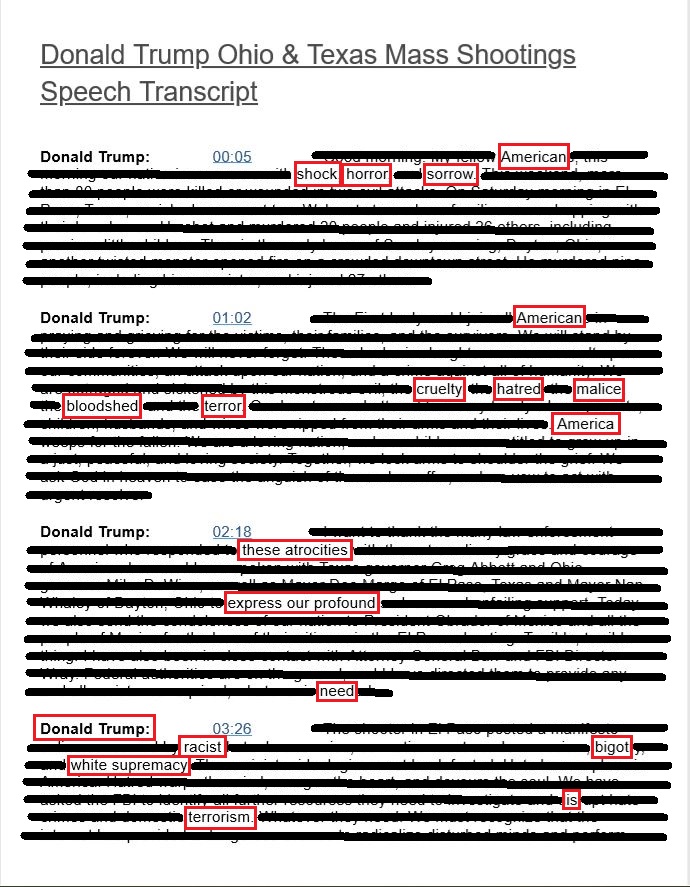
An Original Blackout Poem

August 5, 2019

Links to Online Resources

Erasure and Blackout Poems – Writer’s Digest
5 Tips for Creating Blackout Poetry – powerpoetry.org
Erasure (Artform) – Wikipedia
How to Make Blackout Poetry – Medium.com
Trump Statement on Mass Shootings – Rev.com

Week Ten: The American Cinquain

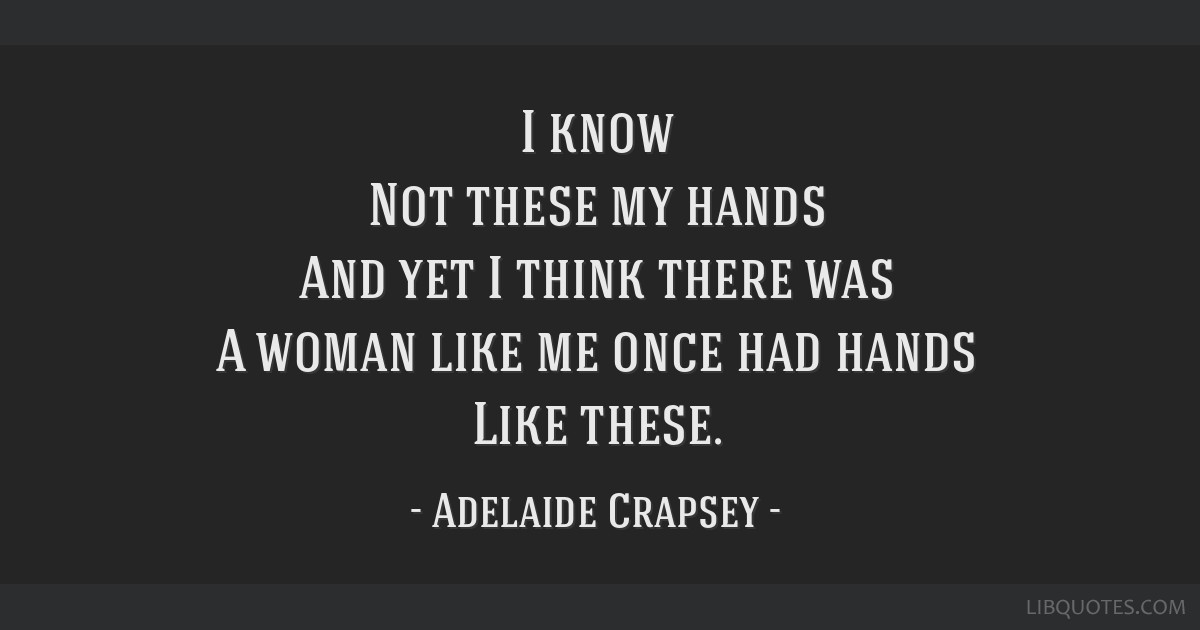
Adelaide Crapsey (1878-1914)

The life of American poet Adelaide Crapsey was both brilliant and brief. Intensely interested in the metrics of poetry, Crapsey had great compact admiration for the meticulousness of the Japanese haiku, and developed her own version of the form, now known as the cinquain (sometimes referred to as the American cinquain to differentiate it from the several variations Crapsey’s original form inspired.) Literature–and poetry in particular–loves a tragic figure, and Crapsey’s fame came after her death from a terminal disease, from which she suffered for many years and greatly influenced the content and tone of her poems. Her first volume of poetry, Verse, was published in 1915.

“Amaze” from Verses (1915)

Variations of the Cinquain

The Didactic Cinquain

The most popular variation of Crapsey’s form is known as the Didactic Cinquain. In this form, words are counted instead of syllables, greatly simplifying the form. Along with the American haiku, didactic cinquains may be one of the first poetic forms you learn about in school. Certain grammatical elements are often assigned to each line to help students learn about grammar at the same time. For more on the didactic cinquain, visit Poet’s Collective.

Requirements of the Form

Structure

– Consists of a short title, followed by a single five-line stanza. The title is not repeated and can be seen as a sixth line. Lines are often enjambed.

Content

– Poet’s choice. However, Crapsey’s cinquains commonly used potent imagery to convey intense mood or feeling.

Syllable Count

– Both syllables and metric feet are carefully counted. The syllable count by line is 2, 4, 6, 8, 2.

Meter

– Poet’s choice, but iambic is generally preferred in English. Since one iambic foot equals two syllables, it fits well within this form.

Rhyme

– Traditionally un-rhymed

Requirements Breakdown

[Title]

[Line 1] Two syllables, one iambic foot
[Line 2] Four syllables, two iambic feet
[Line 3] Six syllables, three iambic feet
[Line 4] Eight syllables, four iambic feet
[Line 5] Two syllables, one iambic foot

The Cinquain

You see,
This form is not
As hard as it might be.
And once you get the hang of it,
It’s fun!

An Original Cinquain

Swimming lessons

For her
dark eyes are pools
for my fool eyes to swim
and all at once I feel I’m made
of waves

Links to Online Resources

Adelaide Crapsey – Poetry Foundation
Cinquain – Writer’s Digest
Cinquain – Wikipedia

Week Nine: The Horatian Ode

Horace (65 – 8 BCE)

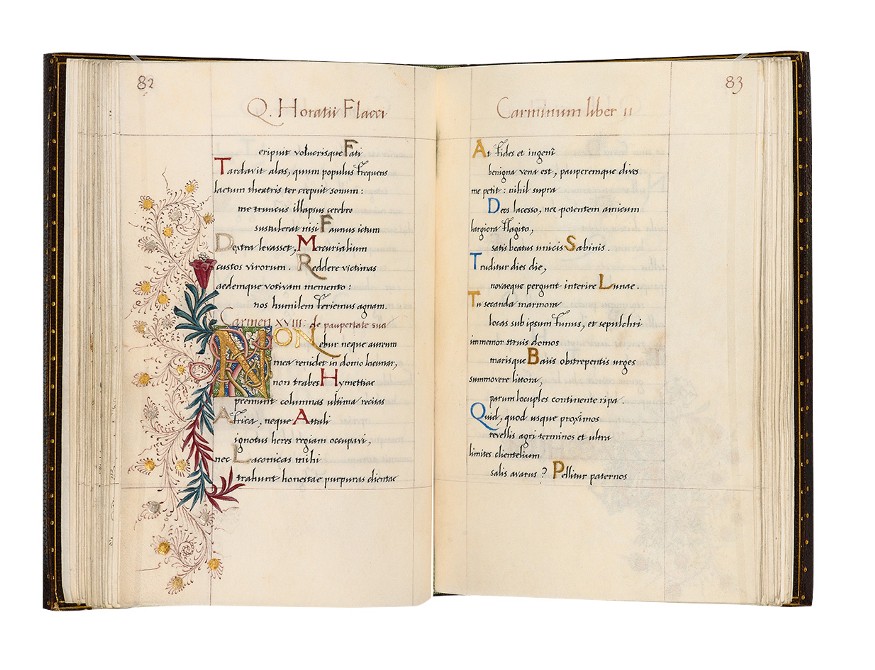
Quintus Horatius Flaccus–better known to the English-speaking world by the mononym Horace–was a Roman soldier, lyric poet and satirist during the time of Augustus. He was a leading Latin poet of his time and is still celebrated for his odes, satires, and epistles. “Ars Poetica,” or “The Art of Poetry,” (c. 19 BC), his most influential epistle, offers advice on the art of writing poetry and drama.

Horatian Odes

Horace studied Greek ode forms–works by celebrated Greek poets such as Alcaeus, Anacreon, and Pindar–and adapted them for his own purposes, making them suitable for Latin. He not only changed the formal conventions of the Greek odes (stanzaic patterns, meter, rhyme scheme), but also modified the tone and subject matter to best highlight his own unique artistic sensibilities. While Greek odes tended to be heroic–elaborately glorifying a person or event–Horace’s odes were more personal, contemplative, and philosophical. The odes of Horace are also known for their charm, sophistication, and occasional touches of light humor.

Reading Horace

Non-Latin readers are immediately confronted with the challenge of translation. It is widely considered a fool’s errand to attempt to preserve formal conventions such as meter and rhyme when translating poetry, so you’ll need to regard any English translations of Horace’s work as approximating the art and meaning of Horace’s original odes, rather than duplicating their formal conventions.

That being said, there is a great deal to be gained by reading Horace–keeping this limitations in mind–in English and many translations are available online. For the bookshelf, I recommend Oxford World’s Classic’s Horace: The Complete Odes and Epodes featuring translations by David West.

A Horatian Ode in English

Although we can’t look directly to Horace to learn the conventions of his signature odes (without first learning Latin, that is), we can, however, look to Horatian odes written in English by English poets, and there are several good examples. Perhaps the most famous of these is Andrew Marvell’s “An Horatian Ode upon Cromwell’s Return from Ireland”.

The forward youth that would appear 
Must now forsake his Muses dear, 
Nor in the shadows sing 
His numbers languishing. 
’Tis time to leave the books in dust, 
And oil th’ unused armour’s rust, 
Removing from the wall 
The corslet of the hall. 
So restless Cromwell could not cease 
In the inglorious arts of peace, 
But thorough advent’rous war 
Urged his active star. 

Scanning the first eight lines of Marvell’s Horatian ode reveals several key requirements of the form. Firstly, you’ll notice each two lines feature an end rhyme in an aabbccdd… pattern. Secondly, you’ll notice that while lines 1 and 2 are written in iambic tetrameter, lines 3 and 4 are written in iambic trimeter. Thirdly, you’ll notice that–and this is an important feature unique to the Horatian ode–the pattern set in the first four lines is repeated without variation in each subsequent quatrain.

Requirements of the Form

Structure

Any number of stanzas that unvaringly follow the pattern set by the first stanza. Stanzas can be of any length, but Horatian odes usually feature repeating stanzas of two to four lines. Enjambment is allowed.

Content

– Tone tends toward philosophical, contemplative, gently playful, tranquil
– Style is sophisticated and formal, but not restrictive

Meter

Meter is chosen at the discretion of the poet. Again, the important factor is consistency from stanza to stanza. Iambic meter is commonly used in English.

Rhyme

Rhyme schemes vary, but (again) subsequent stanzas must repeat the pattern set by the first stanza. Lines are always end-rhymed.

An Original Horatian Ode

A Horatian Ode to the World Goddess

The Goddess of the World, I sing–
Her many forms and faces bring
The light of fertile life,
The fear of judgement’s knife.

Like Draupadi of Indian fame,
Born of the sacrificial flame–
Where she perceives a wall,
Illusion’s palace falls.

Or Anath, golden Canaanite,
Her retribution fierce and right,
She’ll cut you with a word,
Then feed you to the birds.

Online Resources

Ode – Wikipedia
Odes: Praise Poetry! – Writer’s Digest
An Horatian Ode upon Cromwell’s Return from Ireland – Poetry Foundation
Ode – Poetry Foundation
How to Write an Horatian Ode – Forward Poetry
The Horatian Ode – Poetry Magnum Opus

Week Eight: The Cywydd llosgyrnog

The Cywhatnow?

The Cywydd llosgyrnog is the second Welsh form of this challenge and includes many of the features you come to expect from a Welsh form including: strict syllable count, both end rhymes and internal rhymes, and an extremely difficult-to-pronounce (and spell) name!

Using this handy online Guide to Welsh Pronunciation, the best I can suss out as far as the pronunciation of this form would sound something like “kuh-with th-laws-gurr-nog,” but please understand this is only an educated guess.

Requirements of the Form

The Cywydd llosgyrnog form prescribes no restrictions in content or meter, but there are various other requirements that must be adhered to rather strictly.

Form

– Consists of any number of single six-line stanzas (sestets)

Syllable Count

– Lines 1, 2, 4 and 5 contain eight syllables 
– Lines 3 and 6 have seven syllables 

Rhyme

-End rhymes (lines 1-6): aabccb
-Internal rhymes (lines 3 and 6*): ac
*generally falling on syllable 3 or 4

Requirement Breakdown*

1-xxxxxxxa
2-xxxxxxxa
3-xxxaxxb
4-xxxxxxxc
5-xxxxxxxc
6-xxxcxxb

*adapted, with thanks, from Writer’s Digest

An Original Cywydd llosgyrnog

When I stop to watch

When I stop to watch the deep blue
Evening descend and the last few
Fading hues of daylight’s dream
Diffuse into the sloping plains
A peace upon my mind again
Falls like rain into a stream

Online Resources

A Guide to Welsh Pronunciation – go4awalk.com
Cywydd llosgyrnog – Writer’s Digest
Cywydd – Wikipedia
Cywydd llosgyrnog – Poet’s Collective
Cywydd llosgyrnog – Poetry Magnum Opus

Week Seven: The Minute Poem

The Minute Poem is a modern form of unknown origin. Despite it’s name–and fortunately for us–the Minute Poem is not a poem that you must write in 60 seconds. Rather, it’s a poem consisting of exactly sixty syllables. Further requirements in length, meter, and rhyme help this form stand out and make for a fun and fairly simple challenge.

Lucky for us, the Minute Poem counts syllables, not seconds.

Requirements of the Form

Form

– Consists of three quatrains (four-line stanzas) for a total of twelve lines

Meter

– Strict iambic (unstressed-stressed)

Syllable Count

– Eight syllables in the first line of each stanza
– Four syllables in the proceeding lines of each stanza

Rhyme Scheme

aabb/ccdd/eeff

Requirements Breakdown

1-xxxxxxxa
2-xxxa
3-xxxb
4-xxxb

5-xxxxxxxc
6-xxxc
7-xxxd
8-xxxd

9-xxxxxxxe
10-xxxe
11-xxxf
12-xxxf

An Original Minute Poem

I often sleep through summer’s storm

I often sleep through summer’s storm
when nights are warm
and thick with dreams
or so it seems

the quilt pulled high covers my eyes
as lightning flies
like moon in shroud
of creeping cloud

I wake to find the darkened road
the flowers bowed
the sagging sky
the river high

Online Resources

Minute Poetry – Shadow Poetry
Minute Poem – Poetry Dances
Minute Poem – Writer’s Digest