Week Twenty-Three: The Villanelle

Introduction

This 19th century French form uses the circular, controlled repetition of a refrain to allow repeated lines to take on new meaning as the poem progresses. The pastoral elements found in the Italian folk songs that traditionally inspired the form have been stripped away and the topics explored in the modern villanelle now vary greatly. Popular modern villanelles include Dylan Thomas’ “Do not go gentle into that good night”, Elizabeth Bishop’s “One Art” and Theodore Roethke’s “The Waking” (shared below).
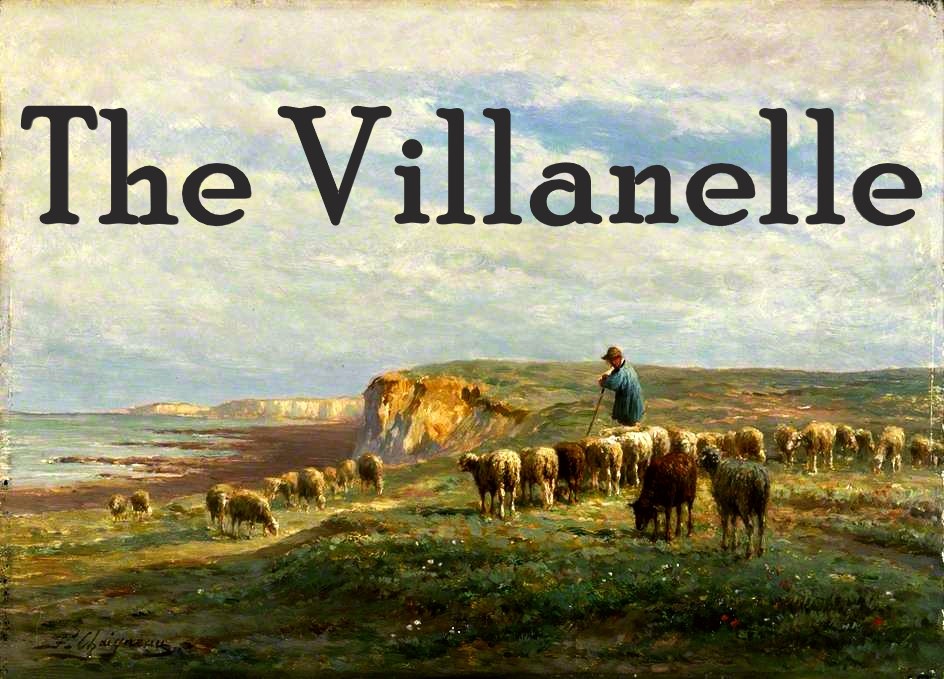
Painting by Ferdinand Chaigneau [fr], 19th century. Wikimedia.

Villanelle Example

Although Dylan Thomas’ “Do not go gentle into that good night” is likely the most widely-known modern villanelle (and one I love and admire), I personally have an equal—perhaps even greater—response to Roethke’s 1953 work, “The Waking.”

The Waking by Theodore Roethke

I wake to sleep, and take my waking slow.   
I feel my fate in what I cannot fear.   
I learn by going where I have to go.

We think by feeling. What is there to know?   
I hear my being dance from ear to ear.   
I wake to sleep, and take my waking slow.

Of those so close beside me, which are you?   
God bless the Ground!   I shall walk softly there,   
And learn by going where I have to go.

Light takes the Tree; but who can tell us how?   
The lowly worm climbs up a winding stair;   
I wake to sleep, and take my waking slow.

Great Nature has another thing to do   
To you and me; so take the lively air,   
And, lovely, learn by going where to go.

This shaking keeps me steady. I should know.   
What falls away is always. And is near.   
I wake to sleep, and take my waking slow.   
I learn by going where I have to go.

Requirements of the Form

Requirements adapted from The Making of a Poem by Mark Strand and Eavan Boland.

Form

– Consists of five stanzas of three lines (tercets), followed by a four-line stanza (quatrain) for a total of nineteen lines

– The first line of the first stanza is repeated as the last line of the second and fourth stanzas

– The third line of the first stanza is repeated as the last line of the third and fifth stanzas

– These two refrain lines follow each other to become the penultimate (second-to-last) and final lines of the poem

~Don’t worry, I’ll break it down for you in a moment~

Content

– Traditional villanelles often featured a pastoral setting

– Modern villenelles are free from thematic restrictions

Rhyme

aba pattern, with rhymes repeated according to the refrains

Meter

– No requirement, though you’ll find some modern examples (like Roethke’s above) are written in iambic pentameter

Variation

Some modern interpretations of the form allow for some variation in the refrain. For examples of this, see Elizabeth Bishop’s “One Art”.

Requirement Breakdown

1. A1  (refrain)
2. b
3. A2 (refrain)

4. a
5. b
6. A1  (refrain)

7. a
8. b
9. A2  (refrain)

10. a
11. b
12. A1  (refrain)

13. a
14. b
15. A2  (refrain)

16. a
17. b
18. A1 (refrain)
19. A2 (refrain)

An Original Villanelle

Bird by Bird [a Villanelle]

I write to write and see my mind in words.
I fear not dullness nor avoid mistake.
I write to write and take it bird by bird.

Ideas they flow though often quite absurd;
These visions form and dream-filled pictures make.
I write to write and see my dreams in words.

But how, you ask, can one with eyes obscured
By sleep-drunk thoughts be made to spring awake?
I write to wake and take it bird by bird.

Although it’s true I’m less than self-assured,
And my neglected voice is sure to shake;
I write to heal and grow through shaking words.

And my unpracticed voice may well be heard,
But I fear not that I’ll be found a fake.
I write to live and see my life in words.
I write to write and take it bird by bird.

A Note on My Original Villanelle

My villanelle is inspired by Anne Lamott’s wonderful guide to writing and the creative life, Bird by Bird. I took a page from Roethke’s book and challenged myself to write my villanelle in iambic pentameter. I also took a page from Bishop’s book and added some variation to the refrain for added impact.

Links to Online Resources

Villanelle – Writer’s Digest
Villanelle – Wikipedia
The Villanelle, a French Form – Washington Post

Print Resources

The Making of a Poem – Mark Strand and Eavan Boland
A Poet’s Glossary – Edward Hirsch
Bird by Bird – Anne Lamott

~

Come back every Friday to see the next form!

~ Creative works are owned by the author and subject to copyright laws ~
Write your own and share in the comments!

Week Twenty-Two: The Haibun

Introduction

The Haibun features a fascinating paring of prose poetry and haiku. It was invented and popularized by 17th century Japanese master poet Matsuo Bashō. The prose and haiku of the haibun are often in communication with each other in direct or subtle ways.

Haibun Example

LAKE SADDLEBAG by marie a. mennuto-rovello

I walk the north end of the lake this time every summer. Listen to the murky green waters slap up against the weather beaten dock. In the distance, the sound of children skinny dipping.

from a navy sky
sound of cicadas calling
full moon on the rise

Requirements of the Form

Structure

– Titled, unlike traditional haiku

– Begins with a small number of short paragraphs (typically one to three) written in prose poetry style

– Ends with a traditional haiku that reflects or is in some relationship with the introductory prose poem

Content

Common elements and themes include:
– Strong sense of place through natural imagery and sensory detail
– Travel or sense of journey
– Autobiographical elements
– Economy of language
– Sense of presence and immediacy typically found in haiku
– Haiku follows other rules typically found in form

Syllable Count

– For the haiku, syllables needn’t be counted 5-7-5 as in the English Haiku. Rather, aim for a short first line, followed by a longer line, ending with another short line. This approach more closely reflects the spirit of the traditional Japanese form.

An Original Haibun

October 28, 2019 [a haibun]

October is ending. The blazing reds of the sugar maple have begun to yellow. I stand at the front window, still in my bathrobe though noon approaches, still fighting a cold with rest and medication. A small grey cat brushes against my leg and then the curtain. Beside her, a fat tabby dozes on a quilt on a rocking chair. Beside the rocking chair, a wastebasket full of crumpled tissues waits to be emptied.

I refill my coffee mug, warming my hands with it as I return to the window. The leaves on the lawn are beginning to brown, reminding me of the promise to rake. Last year we let them lay and they choked the irises. At the feeder, only the occasional finch returns. The water in the birdbath is not yet frozen.

October ends
orange leaves and white snowflakes 
fall together

Links to Online Resources

Haibun – Wikipedia
Haibun Poems – Writer’s Digest
Matsuo Bashō – Wikipedia
A Closer Look at Writing Haibun – Poets.org
Haiku – Wikipedia

~

Come back every Friday to see the next form!

~ Creative works are owned by the author and subject to copyright laws ~

Write your own and share in the comments!

Week Twenty-One: The Clogyrnach

Oh, those plucky Welsh forms with their fun names, lively musicality, strict syllable restrictions and internal rhymes. The Clogyrnach is the third Welsh form so far in this challenge (after the gwawdodyn and the cywydd llosgyrnog) and is just as challenging as its fellow forms.

Requirements of the Form

Like many other Welsh forms, there are no restrictions in content or meter, but there are various other requirements that must be adhered to rather strictly.

Form

– Consists of any number of six-line stanzas (sestets)

Syllable Count

– Lines 1 and 2 contain eight syllables 
– Lines 3 and 4 have five syllables 
– Lines 5 and 6 have three syllables each

Rhyme

-End rhymes (lines 1-6): aabbba

Variations

– There is a five-line variation* of the Clogyrnach which combines lines 5 and 6. (see below for details)

Requirement Breakdown

1-xxxxxxxa
2-xxxxxxxa
3-xxxxb
4-xxxxb
5-xxb
6-xxa

*Form Variation*

1-xxxxxxxa
2-xxxxxxxa
3-xxxxb
4-xxxxb
5-xxbxxa

An Original Clogyrnach

Fall

I love the autumn’s red and gold,
but every fall I catch a cold.
So, I’m stuck in bed
with a stuffy head
until the meds take hold.

I long to stroll beneath the trees
breathing in the October breeze.
Buried in tissues
with sinus issues,
I achoo, cough and wheeze.

Lost leaves scattered across the ground,
pillows piled in a high white mound;
not what I would call
an awesome time, ya’ll.
Love of fall’s got me down.

Links to Online Resources

Clogyrnach – Writer’s Digest
Clogyrnach – Popular Poetry Forms

~

Come back every Friday to see the next form!

~ Creative works are owned by the author and subject to copyright laws ~

Write your own and share in the comments!

Week Twenty: Acrostic Poetry

Introduction

An Acrostic poem uses the first letter of each line to spell a word or name central to the theme of the poem. Acrostics have been used in literature and poetry for many hundreds of years. Even today, they are commonly used as mnemonic devices to aid in memory retention and retrieval.

Form Example

“An Acrostic” by Edgar Allan Poe:

Elizabeth it is in vain you say
Love not”—thou sayest it in so sweet a way:
In vain those words from thee or L.E.L.
Zantippe’s talents had enforced so well:
Ah! if that language from thy heart arise,
Breath it less gently forth—and veil thine eyes.
Endymion, recollect, when Luna tried
To cure his love—was cured of all beside—
His follie—pride—and passion—for he died.

~

An Original Acrostic Poem

Trump – An Acrostic

Dangerous Delusions Direct this
Obnoxious, Obstinate, Orange
Narcissist. Negligence and an
Arrogant Aggression define this
Loud-mouthed Liar, this
Destructive Dimwit whose
Twitter Temper-Tantrums
Repel all but Repugnant Racists.
Unite against this Unwelcome,
Manipulative Misogynist, this
Pussy-grabbing Pig.

Links to Online Resources

Acrostic – Wikipedia
Acrostic Poems & Poetry – Writer’s Digest

~

Come back every Friday to see the next form!

Creative works are owned by the author and subject to copyright laws

Week Eighteen: The Somonka

Introduction

If you enjoyed last week’s form, The Tanka, you should enjoy The Somonka twice as much! It is simply two tankas written in conversation with one another. Traditionally, the somonka reflects upon a theme of love and is written by two authors. But you may find modern somonka written by a single author in two voices. The theme of love may also be adapted and expanded beyond purely romantic sentiments to include love of friends and family, a precious object, or even the world itself.

Example

“Sugar,” by Robert Lee Brewer

I’m waiting to die;
I think it will happen soon–
this morning, I saw
two bright hummingbirds battling
over some sugar water.

I know; I was there.
I chased after them for you
until thirst stopped me.
Fetch me some water. I have
a little sugar for you.

Requirements of the Form

Structure

– Consists of two five-line tankas for a total of ten lines

Content

– Usually revolves around a theme of love
– The second tanka responds to the first in some way

~~For all other requirements, see last week’s post~~

An Original Somonka

Winter/Fall

You love the winter,
the delicacy of snow.
I love your warmth,
the lightness of your fingers,
your perfect paper snowflakes.


You love the autumn
a golden world unfolding
I love your growth
dexterous like a spider
weaving into creation

Notes on Our Original Somonka

Special thanks to my lovely wife, Emily, who contributed the second tanka of this somonka.

Links to Online Resources

Somonka – Writer’s Digest
Somonka – Poet’s Collective
American Tanka
Tanka – Writer’s Digest
Tanka – AHA Poetry

**SHARE YOUR OWN SOMONKA IN THE COMMENTS, AND DON’T FORGET TO COME BACK NEXT WEEK TO SEE THE NEXT FORM: THE ALPHABET POEM!**

–Creative works are owned by the author and subject to copyright laws

Week Seventeen: The Tanka

Introduction

The Tanka is a Japanese form closely related to the haiku. It’s a slightly longer form–made up of a quintet rather than a tercet–but maintains the haiku’s somewhat strict syllable restrictions. While some of the conventions associated with the haiku are still present–such as the focus on imagery–the tone of the tanka may be more conversational. Restrictions on the use of poetic devices such as metaphor and personification are also more relaxed.

Tanka burning Buddhist statues – Wikimedia Commons

Two Paths to the Tanka

There are two ways to approach the syllable requirements of a Japanese form such as the tanka when composing outside of the original language.

One approach uses the syllable requirements of the English haiku (the well known 5-7-5 rule) as a guide. Following this pattern, the syllable count for the tanka would become 5-7-5-7-7. Strict adherence to this method would result in a tanka of exactly thirty-one syllables. Since the way that syllables are counted in the two languages are not directly comparable, this is only an approximation of the original form.

The second approach is to use what I’ll call the short-long-short method, in which the length of the lines, and the difference between them, is more important than the actual syllable count. Using this method, the lines of the tanka would be written short-long-short-long-long. Using this method, the tanka is often shorter than thirty-one syllables (the number of syllables per line is more likely to be lowered than raised). Some would argue that this method is more in the spirit of the original Japanese form.

*Visit American Tanka for more on the history of the tanka.*

A Tanka by Saigyo*

Beside the roadway
a flowing of clear water
in a willow’s shade
I thought for just a short while
to linger and take a rest.

*12th century Japanese poet and priest

Requirements of the Form

Structure

– most often made of a single quintet

Content

Similarities with haiku
– focus on brevity, immediacy
– use of natural imagery
– often features an unexpected “turn” in the final lines of the poem

Differences from haiku
– allows figurative language such as metaphor
– may have relaxed, more conversational tone

Syllable Count

– Option One (Based on English Haiku): 5-7-5-7-7
Option Two (Truer to Japanese Form): Short-Long-Short-Long-Long

Meter

– not typically metrical

Rhyme

– not usually rhymed

Requirements Breakdown

[Line 1] 5 Syllables (short line)
[Line 2] 7 Syllables (longer line)
[Line 3] 5 Syllables (short line)
[Line 4] 7 Syllables (longer line)
[Line 5] 7 Syllables (longer line)

Three Original Tanka

The Artist Knows

The artist knows
the bee in the sunflowers
shares a great lesson:
keep collecting that nectar
and the honey will come.

Volcano

The volcano,
long covered by the blue
ice of the glacier,
will soon strike out with fiery
eruptions of consequence.

Like a Child Moving

Like a child moving
endlessly from game to game
without tiring–
in the hummingbird’s garden
our hearts dance from joy to joy.

Links to Online Resources

American Tanka
Tanka – Writer’s Digest
Tanka – AHA Poetry

**COME BACK NEXT WEEK TO SEE THE NEXT FORM: THE SOMONKA!**

–Creative works are owned by the author and subject to copyright laws

Week Eleven: The Blackout Poem

Blackout Introduction

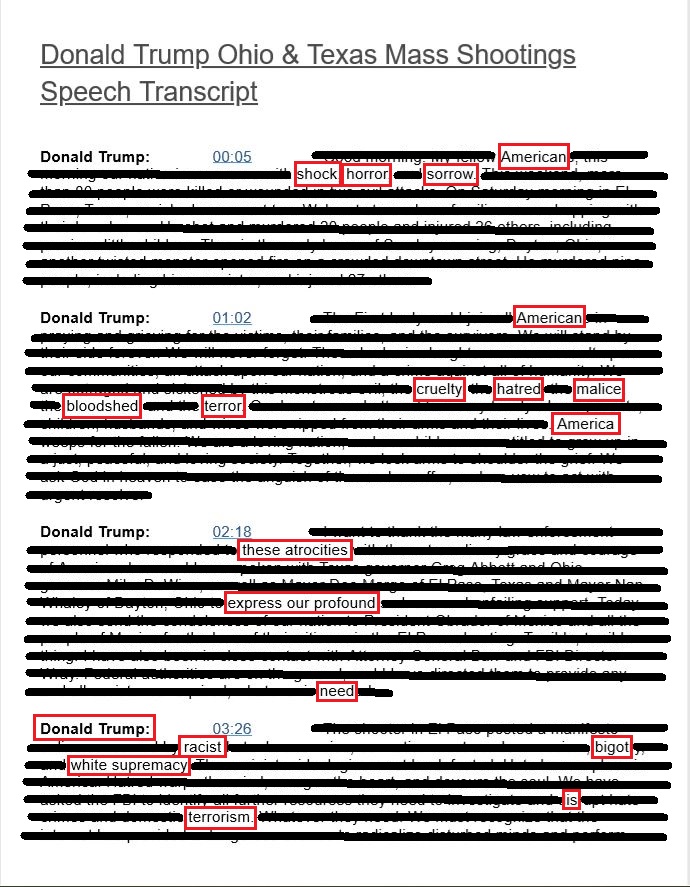
Blackout poetry is a type of erasure poetry that features a strong emphasis on visual presentation. In a blackout poem, a found text is altered in a visually interesting way, emphasizing certain words in order to make a kind of artistic statement. The design of a blackout poem can be as simple or elaborate as the poet pleases.

Notes on Using Found Texts

There are two important things you need to consider before sharing a blackout poem. First, make sure that your original source is cited in some way to avoid potential risk of plagiarism. Second, the original found text must be significantly altered. Robert Lee Brewer at Writer’s Digest states, “If you’re not erasing more than 50% of the text, then I’d argue you’re not making enough critical decisions to create a new piece of art.”

An Original Blackout Poem

August 5, 2019

Links to Online Resources

Erasure and Blackout Poems – Writer’s Digest
5 Tips for Creating Blackout Poetry – powerpoetry.org
Erasure (Artform) – Wikipedia
How to Make Blackout Poetry – Medium.com
Trump Statement on Mass Shootings – Rev.com

The Miltonic Sonnet

52 Forms Revisited: this post has been revised and streamlined with refreshed links and new original content (November 2025)

John Milton (1608-1674)

The Miltonic Sonnet is named after the 17th century English poet, political writer, and civil servant, John Milton. With the publishing of his epic poem Paradise Lost, widely regarded as one of the greatest works written in the English language, Milton solidified his reputation as one of the greatest English poets of his time. Milton’s work would go on to influence Romantic poets such as William Blake and William Wordsworth.

Photo caption: A wood engraving from the 19th century depicts a blind John Milton dictating his influential epic poem “Paradise Lost” (Fortuné Louis Méaulle / Wellcome Library) 

Milton’s Sonnet

Starting with the then-popular Petrachan sonnet (named for Italian poet-scholar Petrach), Milton made several changes to make the form his own. He took the sonnet out of the category of love poem and brought it into the spheres of politics, religion, and social issues. He also introduced enjambment (the technique of carrying one line through into the next), while at the same time removing the break between the first and second stanzas, thus tightening up the form. By removing the volta (also known as a pivot, or turn) after the octave (first eight lines) and varying the rhyme scheme of the sestet (proceeding six lines), he further reshaped the form.

The following poem—one of Milton’s most famous—demonstrates these contributions to the evolution of the sonnet:

“When I Consider How My Light Is Spent”*

When I consider how my light is spent,
    Ere half my days in this dark world and wide,
    And that one talent which is death to hide
Lodged with me useless, though my soul more bent
To serve therewith my Maker, and present
    My true account, lest He returning chide;
    “Doth God exact day-labor, light denied?”
I fondly ask. But Patience, to prevent
That murmur, soon replies, “God doth not need
    Either man’s work or His own gifts. Who best
    Bear His mild yoke, they serve Him best. His state
Is kingly: thousands at His bidding speed,
    And post o’er land and ocean without rest;
   They also serve who only stand and wait.”

*provided courtesy of Poetry Foundation

Requirements of the Form

Structure

– Fourteen lines
– No spaces between parts (written as a single stanza)
– Lines contain enjambment
eg: Who best / Bear His mild yoke…His state / Is kingly…

Content

– Occasional (celebrating an event), political, and religious subjects
– Unlike other sonnets, does not have a distinct volta (or pivot) after the eighth line

Meter

Iambic pentameter (ten syllables per line, unstressed-stressed pattern).

Rhyme Scheme

– First eight lines (octave): abbaabba
– Preceding six lines (sestet): often cdecde, but variable

An Original Miltonic Sonnet

The viral image haunted every screen—
A photograph too horrid to ignore:
A pair of bloated bodies on the shore.
In Congress followed yet another scene
Of bickering and washing white-hands clean.
No older than The Virgin when she bore
The Savior that they claim to so adore,
The budding mother wonders what they mean.
As children hungry, dirty, sick and scared
Are torn away and locked in concrete halls
Lay weak with worry, overwhelmed with fear,
The value of their lives is weighed and tared;
As Washington debates the costs of walls,
Who dares to speak of Christ’s compassion here?

Notes on My Original Sonnet

I challenged myself to write a sonnet that was true to the Miltonic themes of politics, religion, and current events, and found in the issue of immigration a combination of all three. The line “children hungry, dirty, sick and scared” was taken from this BBC News article and served as the fulcrum of this poem.

Online Resources


Sonnet Examples – Poetry Through the Ages
Miltonic Sonnet – Poetry Magnum Opus
John Milton – Wikipedia
Petrarchan Sonnet – Wikipedia

Fifty-Two Forms Poetry Challenge: Introduction

Wordsmiths and Versifiers,
Rhymesters and Sonneteers,
Bards and Balladeers…

Welcome to the Fifty-Two Form
Poetry Challenge!

The Challenge: Fifty-Two Forms in Fifty-Two Weeks.

In preparation for this challenge, I’ve collected as many unique poetic forms as I could find, giving each a number. Over the next 52 weeks, I’ll randomly select one form each week and make my best attempt to write an original poem, taking care to follow the chosen form’s particular conventions. I’ll share what I’ve learned along the way, with lots of links to further resources that I’ve found useful.

In each weekly post, I’ll provide an overview of the selected form, including a brief history, specific form requirements (meter, rhyme, syllable-count, etc.), and a few tips and techniques I found useful when working in the form. Each post will conclude with an original poem.

What you’ll need to play along:

A list of at least 52 unique forms. I suggest collecting as many as you can (why not?). Robert Lee Brewer’s List of 168 Poetic Forms for Poets is a great place to start. Assign a number to each form you collect.

A way to randomly select a number from 1 to 52. You can use an online random-number generator or fifty-two slips of paper in a ten-gallon hat. Have fun with it!

About the Author

I am not a professional writer or even a published poet. I am not a professor, scholar, or literary historian, and I speak with little authority on the subject of poetry as a whole. I do, however, consider myself an earnest enthusiast and lifelong student of poetry. As an undergrad, I had the extreme privilege of studying creative writing under former Kansas Poet Laureate Kevin Rabas at Emporia State University, and poetry under another Kansas Poet Laureate, the wonderful Eric McHenry, at Washburn University in Topeka.

As a songwriter, I’m especially interested in the intersection between music and poetry, and I’m excited to explore all the possible ways I may find to incorporate aspects of what I learn through this process into my songwriting endeavors. I believe all things are enhanced by the clarity, power, and imagination that a poetic perspective can bring.

This is my first attempt at such a lengthy challenge, and will also be my first time regularly publishing online. I embark on this adventure on the day of my 36th birthday. Please wish me luck, courage, and fortitude!

References and Acknowledgements

Robert Lee Brewer’s List of 168 Poetic Forms for Poets for The Writer’s Digest [updated 4/1/25] served both as an inspiration for the project and an essential online source of reference information and examples.

Edward Hirsch’s 700+ page A Poet’s Glossary is an exhaustive and equally indispensable source of both information and inspiration. Hirsch’s How to Read a Poem is also highly recommended.

Both aspiring and long-practicing poets would do well to keep a copy of Mary Oliver’s concise and gracefully crafted A Poetry Handbook close at hand.

On a more personal note, a special thanks to Eric McHenry for his invaluable guidance and enthusiastic support.