The Ovillejo

52-Forms Revisited: This post has been revised and streamlined with refreshed links and new original content (November 2025)

The Ingenious Gentleman Cervantes

The Ovillejo is the first form of this challenge with a lineage that can be traced back to a single well-known source: Miguel de Cervantes’ epic comedy (or is it a tragedy?) The Ingenious Gentleman Sir Quixote of La Mancha, better known today as Don Quixote (1605).

Untangling the Ovillejo

Ovillo in Spanish means “ball.” A Poet’s Glossary explains: “The word ovillego refers to a spool of thread or wool, and this complicated Spanish stanzaic form is tied in a little knot [which] unravels in ten lines.”

Learning by Example

The Ovillejo is a complex form which can perhaps be best grasped through example. Below is an excerpt from Paul Archer’s English translation of Miguel de Cervantes’ poem, “Ovillejos” from Don Quixote, followed by the original Spanish version.

Ovillejos (Archer Translation)

What undermines all I attempt?
Contempt!
What heaps sorrow onto me?
Jealousy!
And what gnaws me through and through?
Missing you!

That’s why nothing will do
to make my distress less –
I’m killed by hopelessness,
contempt, jealousy and missing you!

Ovillejos (Original Spanish)

¿Quién menoscaba mis bienes?
¡Desdenes!
Y ¿quién aumenta mis duelos?
¡Los celos!
Y ¿quién prueba mi paciencia?
¡Ausencia!

De este modo en mi dolencia
ningún remedio se alcanza,
pues me matan la esperanza,
desdenes, celos y ausencia.

Translation vs Original

Translation of poetry from any language is a task fraught with challenges both practical and creative—the phrase “lost in translation” has become cliché for good reason. In a form with as many requirements as this has, you’ll likely have to make some compromises. Even a non-Spanish speaker should notice that Archer’s translation has preserved the original’s punctuation (excepting the exclamation in the last line) and rhyme scheme. One thing that is lost, however, is the syllable count. The lesson here is you can’t rely solely on any translation to learn the requirements of a given form.

Form Requirements

Structure:
– The Ovillejo is a poem consisting of ten lines

– These ten lines are usually made up of a sestet (6 line stanza) and a quatrain (4 line stanza)

– Any number of Ovillejos can be connected to create a sequence (you’ll see here that Cervantes’ “Ovillejos” is a sequence of three Ovillejos)

Content:
– Lines 1, 3, and 5 of the first stanza must ask a question, which the preceding line (2, 4, 6) must answer

– The second stanza reflects and amplifies the first stanza

– The last line of the second stanza must be a culmination of lines 2, 4, and 6 of the previous stanza (this is known as a redondilla). The exclamation point on the final line appears to be optional.

Rhyming:
– The first stanza can either be seen as three couplets, or a sestet, with an aa bbcc rhyme scheme

– The second stanza is always a quatrain, with a cddc rhyme scheme

Syllable Count:
– In the first stanza, lines 1 ,3, and 5 consist of eight syllables. Lines 2, 4, and 6 consist of two to three syllables

– Lines 7, 8, and 9 consist of eight syllables in the second stanza

– The final line should consist of seven to ten syllables

If all of these rules are leaving your brain feeling like a ball of tangled yarn, here’s a breakdown:

Ovillejo Requirement Breakdown*

Line 1: a rhyme in 8 syllables (question)
Line 2: a rhyme in 2-3 syllables (single word exclamation)
Line 3: b rhyme in 8 syllables (question)
Line 4: b rhyme in 2-3 syllables (single word exclamation)
Line 5: c rhyme in 8 syllables (question)
Line 6: c rhyme in 2-3 syllables (single word exclamation)

Line 7: c rhyme in 8 syllables
Line 8: d rhyme in 8 syllables
Line 9: d rhyme in 8 syllables
Line 10: (Line 2)+(Line 4)+(Line 6) (optional exclamation)

*line breakdown adapted from Writer’s Digest

An Original Ovillejo

What do we say when men oppress?
Confess!
To those who drink as others drown?
Step down!
And after we destroy the throne?
Atone!

To prove your soul’s not made of stone,
There’s nothing that you need to do
But lift your polished, deadly shoe,
Confess, step down, and atone.

~Ovillejo Revisited & Revised~

Ovillejo

What do we say when men oppress?
Confess!
To those who build on broken ground?
Step down!
And when the tyrant’s overthrown?
Atone!

You cannot rule by wealth alone;
You cannot sell a country’s soul.
Resign, retire—go count your gold.
Confess, step down, atone.

Notes on my revision

Title
I added a title with this revision. Not a very creative one, admittedly.

Revised Lines
Upon revisiting, I wasn’t entirely satisfied with lines 2 and 4, and 7 through 9. So I created an expanded list of rhyme pairings, and, after carefully considering my syllables, landed on these new lines. I believe (hope) they paint a clearer picture and more directly express the purpose of the poem.

Online Resources:

Top 10 Question Poems – Tweetspeak
Ovillejo – Writer’s Digest
Ovillejos – Paul Archer (Translator of Cervantes)
Ovillejo – Dark Side of the Moon
Ovillejo – Popular Poetry Forms
Unraveling the Ovillejo – dVerse Poets

The Magic 9

52-Forms Revisited: This post has been revised and streamlined with refreshed links and expanded original content (November 2025)

The Mysterious Magic 9

The Magic 9 is a newer form with uncertain origins. The idea for the rhyme scheme is rumored to have sprung from the rushed misspelling of the famous incantatory exclamation: abacadabra!

Structure of the Magic 9 Poem

Requirements of the Magic 9 form:

– Comprised of a single nine-line stanza

– Must follow the rhyme scheme: abacadaba

– No restrictions on line length, meter or subject matter

Tips and Techniques

One way to get started is to make a list of end words.

To do this form correctly you’ll need:
– 5 a end rhymes
– 2 b end rhymes
– 1 c end word
– 1 d end word

Determine what kind of end rhymes you’d like to use. Click here for a handy guide on the different rhyme types used in poetry.

First try single-syllable end rhyme words, and then expand to two or even three-syllable words. Consider how these changes feel and how each possibility resonates within the structure of the form.

Now brainstorm around your favorite end rhyme clusters, looking for meaningful ways of bringing them together.

Keep it loose at the beginning and let the creativity flow. Your internal editor is not allowed in this free-flowing creative space, so don’t stop to judge or think too critically–that’s what revision is for.

An Original Magic 9 Poem

The Stargazers

Away from the glare of the city’s light,
We follow the firefly’s flash.
Abandoning the screens that so narrow our sight,
We trace the heavens for our favorite constellations.
With galaxies and gods, all going ’round in our flight,
We lay down our blanket in a hidden patch of prairie.
In this brilliant darkness, our vision’s set right,
As the dazzling meteors slash
Across the impossible night.

Links to Online Resources:

Types of Rhyme – Daily Writing Tips

~Magic 9 Revisited~

Rather than creating a new poem in the Magic 9 form, I thought I’d share the lyrics to a song I wrote using The Stargazers as a jumping off point. I often look for ways to use formal poetry as a springboard into songwriting.


Escape to the Cosmos

The city at night is a lovely sight,
But the lights can strain your eyes.
I know of a grove off a dark country road.
Why don’t we go for a ride?

We’ll slip away when the daylight fades
And the stars begin to shine.
The clouds have all cleared, and the moon’s not too bright.
We’ll escape to the cosmos tonight.

Far from the bars, the streetlights, and cars,
We’ll lay our blankets down,
Trace the constellations from our bed in the weeds,
And share all the wonders we’ve found.

We’ll slip away when the daylight fades
And the stars begin to shine.
With galaxies and gods, all goin’ round in our flight,
We’ll escape to the cosmos tonight.

The fireflies flash, the meteors dash
All across the impossible sky.

We’ll slip away when the daylight fades
And the stars begin to shine.
In this brilliant darkness, our vision’s set right.
We’ll escape to the cosmos tonight.


Hear it at:
Bandcamp
YouTube
Spotify

Week Nine: The Horatian Ode

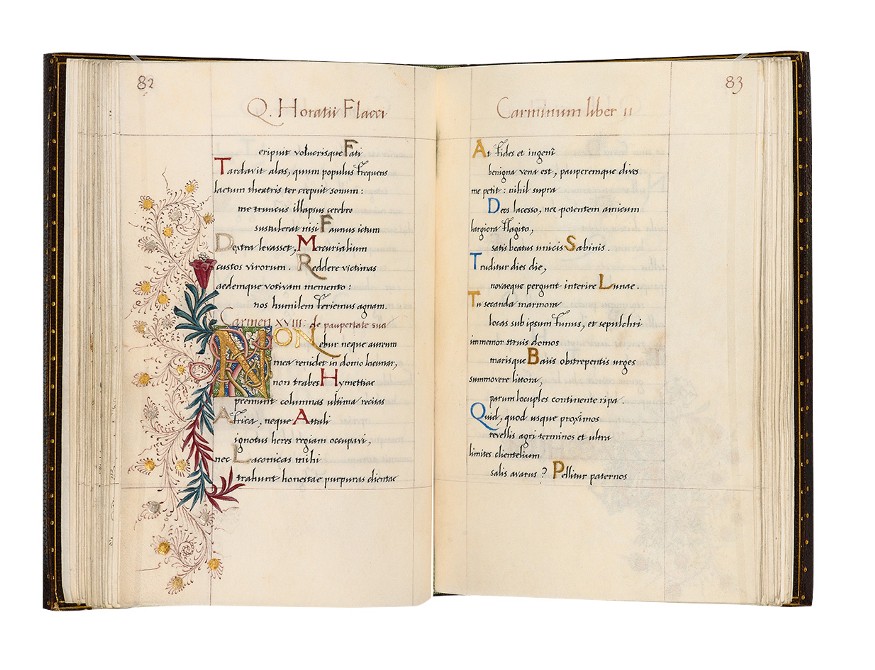
Horace (65 – 8 BCE)

Quintus Horatius Flaccus–better known to the English-speaking world by the mononym Horace–was a Roman soldier, lyric poet and satirist during the time of Augustus. He was a leading Latin poet of his time and is still celebrated for his odes, satires, and epistles. “Ars Poetica,” or “The Art of Poetry,” (c. 19 BC), his most influential epistle, offers advice on the art of writing poetry and drama.

Horatian Odes

Horace studied Greek ode forms–works by celebrated Greek poets such as Alcaeus, Anacreon, and Pindar–and adapted them for his own purposes, making them suitable for Latin. He not only changed the formal conventions of the Greek odes (stanzaic patterns, meter, rhyme scheme), but also modified the tone and subject matter to best highlight his own unique artistic sensibilities. While Greek odes tended to be heroic–elaborately glorifying a person or event–Horace’s odes were more personal, contemplative, and philosophical. The odes of Horace are also known for their charm, sophistication, and occasional touches of light humor.

Reading Horace

Non-Latin readers are immediately confronted with the challenge of translation. It is widely considered a fool’s errand to attempt to preserve formal conventions such as meter and rhyme when translating poetry, so you’ll need to regard any English translations of Horace’s work as approximating the art and meaning of Horace’s original odes, rather than duplicating their formal conventions.

That being said, there is a great deal to be gained by reading Horace–keeping this limitations in mind–in English and many translations are available online. For the bookshelf, I recommend Oxford World’s Classic’s Horace: The Complete Odes and Epodes featuring translations by David West.

A Horatian Ode in English

Although we can’t look directly to Horace to learn the conventions of his signature odes (without first learning Latin, that is), we can, however, look to Horatian odes written in English by English poets, and there are several good examples. Perhaps the most famous of these is Andrew Marvell’s “An Horatian Ode upon Cromwell’s Return from Ireland”.

The forward youth that would appear 
Must now forsake his Muses dear, 
Nor in the shadows sing 
His numbers languishing. 
’Tis time to leave the books in dust, 
And oil th’ unused armour’s rust, 
Removing from the wall 
The corslet of the hall. 
So restless Cromwell could not cease 
In the inglorious arts of peace, 
But thorough advent’rous war 
Urged his active star. 

Scanning the first eight lines of Marvell’s Horatian ode reveals several key requirements of the form. Firstly, you’ll notice each two lines feature an end rhyme in an aabbccdd… pattern. Secondly, you’ll notice that while lines 1 and 2 are written in iambic tetrameter, lines 3 and 4 are written in iambic trimeter. Thirdly, you’ll notice that–and this is an important feature unique to the Horatian ode–the pattern set in the first four lines is repeated without variation in each subsequent quatrain.

Requirements of the Form

Structure

Any number of stanzas that unvaringly follow the pattern set by the first stanza. Stanzas can be of any length, but Horatian odes usually feature repeating stanzas of two to four lines. Enjambment is allowed.

Content

– Tone tends toward philosophical, contemplative, gently playful, tranquil
– Style is sophisticated and formal, but not restrictive

Meter

Meter is chosen at the discretion of the poet. Again, the important factor is consistency from stanza to stanza. Iambic meter is commonly used in English.

Rhyme

Rhyme schemes vary, but (again) subsequent stanzas must repeat the pattern set by the first stanza. Lines are always end-rhymed.

An Original Horatian Ode

A Horatian Ode to the World Goddess

The Goddess of the World, I sing–
Her many forms and faces bring
The light of fertile life,
The fear of judgement’s knife.

Like Draupadi of Indian fame,
Born of the sacrificial flame–
Where she perceives a wall,
Illusion’s palace falls.

Or Anath, golden Canaanite,
Her retribution fierce and right,
She’ll cut you with a word,
Then feed you to the birds.

Online Resources

Ode – Wikipedia
Odes: Praise Poetry! – Writer’s Digest
An Horatian Ode upon Cromwell’s Return from Ireland – Poetry Foundation
Ode – Poetry Foundation
How to Write an Horatian Ode – Forward Poetry
The Horatian Ode – Poetry Magnum Opus

Fifty-Two Form Poetry Challenge: Introduction

Wordsmiths and Versifiers,
Rhymesters and Sonneteers,
Bards and Balladeers…

Welcome to the Fifty-Two Form
Poetry Challenge!

The Challenge: Fifty-Two Forms in Fifty-Two Weeks.

In preparation for this challenge, I’ve collected as many unique poetic forms as I could find, giving each a number. Over the next 52 weeks, I’ll randomly select one form each week and make my best attempt to write an original poem, taking care to follow the chosen form’s particular conventions. I’ll share what I’ve learned along the way, with lots of links to further resources that I’ve found useful.

In each weekly post, I’ll provide an overview of the selected form, including a brief history, specific form requirements (meter, rhyme, syllable-count, etc.), and a few tips and techniques I found useful when working in the form. Each post will conclude with an original poem.

What you’ll need to play along:

A list of at least 52 unique forms. I suggest collecting as many as you can (why not?). Robert Lee Brewer’s List of 168 Poetic Forms for Poets is a great place to start. Assign a number to each form you collect.

A way to randomly select a number from 1 to 52. You can use an online random-number generator or fifty-two slips of paper in a ten-gallon hat. Have fun with it!

About the Author

I am not a professional writer or even a published poet. I am not a professor, scholar, or literary historian, and I speak with little authority on the subject of poetry as a whole. I do, however, consider myself an earnest enthusiast and lifelong student of poetry. As an undergrad, I had the extreme privilege of studying creative writing under former Kansas Poet Laureate Kevin Rabas at Emporia State University, and poetry under another Kansas Poet Laureate, the wonderful Eric McHenry, at Washburn University in Topeka.

As a songwriter, I’m especially interested in the intersection between music and poetry, and I’m excited to explore all the possible ways I may find to incorporate aspects of what I learn through this process into my songwriting endeavors. I believe all things are enhanced by the clarity, power, and imagination that a poetic perspective can bring.

This is my first attempt at such a lengthy challenge, and will also be my first time regularly publishing online. I embark on this adventure on the day of my 36th birthday. Please wish me luck, courage, and fortitude!

References and Acknowledgements

Robert Lee Brewer’s List of 168 Poetic Forms for Poets for The Writer’s Digest [updated 4/1/25] served both as an inspiration for the project and an essential online source of reference information and examples.

Edward Hirsch’s 700+ page A Poet’s Glossary is an exhaustive and equally indispensable source of both information and inspiration. Hirsch’s How to Read a Poem is also highly recommended.

Both aspiring and long-practicing poets would do well to keep a copy of Mary Oliver’s concise and gracefully crafted A Poetry Handbook close at hand.

On a more personal note, a special thanks to Eric McHenry for his invaluable guidance and enthusiastic support.